How to Choose a Performing Arts Studio for Kids in the San Gabriel Valley
The San Gabriel Valley has a genuinely active youth performing arts market. Families in Arcadia, Monrovia, Temple City, and Pasadena can choose from established dance academies, theatre programs, and multi-discipline studios, which is great, and also makes the decision harder. Knowing how to choose a performing arts studio for kids in the San Gabriel Valley comes down to three things: matching the studio’s mission to your child’s goals, verifying what you cannot see on a website (floor type, instructor credentials, curriculum structure), and understanding the true cost before you sign. This guide gives you a framework for all three, across dance, acting, and vocal tracks.
What Discipline Should Your Child Start With?
Start with what your child gravitates toward, not what you think will look best on a resumé. If they are undecided, a multi-discipline academy that offers dance, acting, and vocal training under one roof lets them sample all three before committing to one path, and cross-training in movement, voice, and performance technique pays off in every discipline.
| Discipline | Earliest Productive Start Age | What Kids Gain First | Good Fit If Your Child… |
|---|---|---|---|
| Dance | 3–4 (creative movement); 5–6 for structured technique | Coordination, rhythm, body awareness, confidence | Loves moving to music, has high physical energy |
| Acting / Theatre | 5–7 for play-based; 8+ for scene work | Emotional expression, listening, storytelling, public speaking | Is naturally imaginative, likes telling stories or performing for family |
| Vocal / Idol Track | 7–8 for structured lessons; earlier for music exposure | Pitch accuracy, breath control, ear training, performance confidence | Hums constantly, loves pop music, wants to perform on a stage or screen |
Dance classes for toddlers (ages 3–4) are most productive when framed as creative movement rather than formal technique, the real goal at that age is developing motor skills and comfort in a group setting. Structured technique, including correct ballet or jazz alignment, makes sense starting around age 5 or 6. For singing, most voice educators agree that formal vocal lessons become genuinely effective around ages 7–8, when children have the breath control, focus span, and pitch awareness to benefit from technical instruction. Acting can start earlier than either, since play-based drama at ages 5–7 builds listening skills and emotional vocabulary that support all performing arts work later on.
If your child shows interest in the Korean pop / idol performance style, CTA’s own Mystic Inscho’s journey from CTA to the global idol stage shows what a dedicated multi-discipline vocal-and-performance track can build from a young age in the SGV.
What Should You Look for in a Dance Studio Specifically?
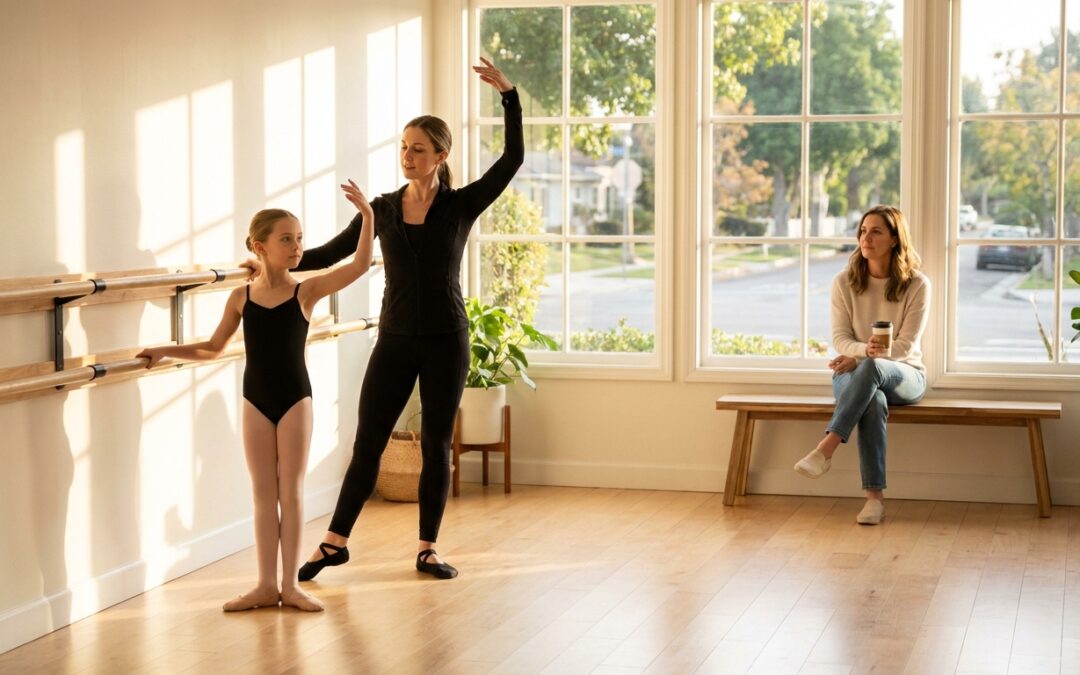
The floor is the single most important physical feature in any dance studio. Sprung wooden or floating Marley floors absorb shock and reduce impact on growing joints, a concrete subfloor, or thin vinyl laid over concrete, dramatically increases the risk of shin splints, stress fractures, and knee injuries over time. Ask directly: “What is your floor construction?” If the answer is unclear, look for visible flex when you walk across it.
Beyond the floor, check these five things on your tour:
- Instructor credentials: Look for documented training in the style they teach (RAD, ISTD, or equivalent for ballet; recognized hip-hop or contemporary lineage for commercial styles). A credential is not a guarantee of great teaching, but it shows the instructor has been evaluated by a third party.
- Class grouping: Quality studios group students by both age and experience level, not age alone. A 9-year-old beginner should not be in the same class as a 9-year-old who has trained for four years.
- Curriculum structure: Skills should build from class to class on a written progression, not the same choreography recycled each term. Ask: “How does a student advance from one level to the next?”
- Class size: Smaller is better for technique work. A group of 8–12 allows the instructor to correct alignment and provide individual feedback; more than 15–18 in a technique class is a red flag.
- Parent observation policy: Many studios designate specific observation weeks rather than open-door every class. This is normal and protects class focus, but you should have at least one scheduled opportunity to watch each term.
Recreational vs. Competitive vs. Pre-Professional: Which Track Fits Your Family?
This is the decision most parents underestimate. Studios broadly fall into three mission types, and mismatching your child to the wrong one causes burnout, frustration, and wasted tuition.
| Track | Primary Goal | Time Commitment | Cost Level | Choose If… |
|---|---|---|---|---|
| Recreational | Fun, fitness, creativity, confidence | 1–2 classes/week | Lower (one tuition, one recital) | Child is exploring, family has limited schedule, or performing arts is one of several activities |
| Competitive | Technique mastery, placement at adjudicated competitions | 3–6+ classes/week plus rehearsals | Higher (comp fees, costume costs, travel) | Child is passionate and motivated, family can commit weekends, child handles constructive criticism well |
| Pre-Professional / Audition Prep | Industry readiness: auditions, productions, idol/screen track | Intensive, often including summer programs | Highest, but also highest ROI for serious students | Teen has a specific career goal, or younger child shows exceptional drive and has already thrived in recreational and competitive settings |
The SGV market includes studios at every level. The key question for any studio you tour is: “What percentage of your students are on the competitive or performance track, and how does that affect recreational classes?” At some heavily competitive studios, the recreational program becomes secondary, class times shift around team rehearsals, and recreational students feel like second-tier members. A studio with a genuine multi-track structure protects every student’s experience.
If your child is drawn toward the pre-professional and audition-prep pathway, CTA’s partnership detailed in the post about professional dance training coming to Arcadia gives you a clear picture of what a structured, industry-connected pre-professional program looks like in the SGV.
What Does Youth Performing Arts Training Actually Cost in the San Gabriel Valley?
Budget transparency is one of the biggest gaps in how SGV studios communicate with families. Here is a realistic breakdown of what to expect:
- Monthly tuition: Group dance classes typically run $60–$200 per month, with $40 per week as a common benchmark for one class. Acting and vocal group classes fall in a similar range; private lessons run significantly higher.
- Annual registration fee: Most studios charge a non-refundable registration or enrollment fee, typically $25–$50 per student per year. This is separate from tuition.
- Recital and costume fees: End-of-season recital costs are a real budgeting factor. Costume fees per costume commonly run $60–$120+, and some studios charge a separate recital ticket or production fee. Confirm these before enrolling.
- Competitive track add-ons: Competition entry fees, travel, and additional rehearsal sessions are billed on top of base tuition and can add several hundred to several thousand dollars per season.
- Summer intensives: Priced separately from the year-round program, often in the range of a few hundred dollars per week for a quality intensive.
Ask any studio for a complete fee schedule in writing before you enroll. A studio that hedges on this question, or that hands you a tuition sheet without mentioning registration and recital costs, is setting you up for surprise invoices.
What Questions Should You Ask on the Studio Tour or Trial Class?
Most reputable performing arts studios offer a free or low-cost trial class and a facility tour before you commit. Use both. Here are 15 specific questions to bring:
About the Instructors
- What formal training do your instructors have in the styles they teach?
- Are instructors employees or independent contractors, and how long have they been with this studio?
- For acting: what is the instructor’s professional performance or directing background?
- For vocal / idol track: has the instructor worked with students who have pursued professional auditions or competitions?
About the Curriculum and Progression
- What written curriculum or syllabus guides each level?
- How and when does a student move from one level to the next, is it by age, by skill assessment, or by time enrolled?
- How many students are typically in the class my child would join?
About Facilities
- What is the floor construction in the dance studios? (Sprung wood or floating Marley only, not concrete.)
- Is there a waiting or observation area for parents during class?
- How is the studio heated and cooled? (Extreme temperatures affect both safety and focus.)
About Costs and Commitment
- What is the full annual cost including registration, tuition, costume, and recital fees?
- What is your makeup class or absence policy?
- Is tuition month-to-month or is there a minimum enrollment commitment?
- What happens if my child wants to add a second discipline mid-year, is there a multi-class discount?
- What does the summer program look like, and is it included or a separate cost?
How Do You Evaluate a Studio’s Teaching Approach for Acting?
For kids’ acting classes specifically, the teaching approach matters more than the studio’s production schedule. Casting directors and acting coaches consistently note that young performers do best when they are coached toward authentic, natural delivery rather than over-rehearsed polish. Ask to observe a class (or watch a sample video) and look for whether the instructor is encouraging honest emotional response or drilling line readings. A class where kids are laughing, taking risks, and getting genuine feedback is a better sign than a perfectly choreographed showcase rehearsal.
Also ask whether the studio has a performing community, student showcases, in-studio productions, or audition opportunities, because young actors develop most quickly when they have real performance experience, not just classroom exercises. A supportive peer community, where students cheer each other on rather than compete for spotlight, signals a healthy studio culture.
Why a Multi-Discipline Academy Changes the Calculation for SGV Families
Most local and national guides treat the “which studio” question as discipline-specific: dance parents read dance guides, acting parents read theatre guides. But many SGV families have a child who is drawn to all three, or who is genuinely undecided. A multi-discipline academy, one with dance, acting, and a structured vocal or idol-track program under the same roof, solves several problems at once:
- Your child can sample all three disciplines without switching studios or rebuilding trust with new instructors.
- Cross-training is built in: a student in acting class naturally develops the physicality that improves their dance; vocal training sharpens the ear that supports musical theatre choreography.
- Summer intensives can combine disciplines in a single week, offering real depth without a year-long commitment.
- Audition prep draws on all three disciplines simultaneously, exactly how professional auditions work.
For SGV students pursuing the idol or K-pop performance track in particular, the multi-discipline model is not optional, it is the standard. That track requires synchronized movement, live vocal performance, and stage presence as a unified skill set, which a single-discipline studio simply cannot develop. CTA’s idol-track alumni like Mystic Inscho demonstrate what that integrated training produces at a competitive level.
Common Mistakes to Avoid
- Choosing based on recital production value alone. A flashy annual showcase signals a marketing budget, not necessarily strong day-to-day instruction. Ask to observe a regular class, not just a recital video.
- Ignoring the floor. Concrete or hard-surface floors under dance students cause real injuries over a season. This is non-negotiable, always ask.
- Underestimating the total annual cost. Monthly tuition is only part of the number. Add registration, costume, recital, and competition fees before comparing studios.
- Enrolling a child in a competitive track because “it shows commitment.” Competitive programs require 3–6+ classes per week plus rehearsals. Placing a child in a competitive track before they have expressed genuine motivation leads to burnout, not advancement.
- Choosing the nearest studio by default. The SGV has enough quality options within a short drive that proximity alone is a poor deciding factor. A 10-minute longer commute to the right studio is worth it over a full year of training.
- Not using the trial class. A free or low-cost trial class is the most reliable data point you will get. Watch how the instructor handles a child who makes a mistake, that response tells you more than any website or parent review.
- Skipping the vocal or idol track because it seems niche. Vocal training is one of the most underdeveloped disciplines in SGV youth arts programs. A student who adds voice to their dance and acting training becomes a more competitive auditioner at every level, from school musicals to professional callbacks.
Frequently Asked Questions
What is the best age to start dance classes for kids in Arcadia or the SGV?
Children as young as 3–4 can benefit from creative movement classes that build coordination and rhythm without formal technique demands. Structured dance technique, including correct alignment for ballet, jazz, or hip-hop, becomes productive around ages 5–6. The most important factor is not age but whether your child can follow basic group instructions and engage for the length of a class.
How much do youth performing arts classes cost in the San Gabriel Valley?
Budget $60–$200 per month for group classes, depending on the studio and discipline, with roughly $40 per week as a common midpoint. Add a one-time annual registration fee of $25–$50, plus end-of-year costume and recital fees that can run $60–$120 or more per costume. Competitive-track families should budget several hundred to several thousand dollars additional per season in competition entry and travel costs.
What is the difference between a recreational and a competitive dance studio?
Recreational studios prioritize fun, fitness, creativity, and one annual recital, with a commitment of one to two classes per week. Competitive studios build toward adjudicated competitions, requiring three to six or more classes per week, intensive rehearsals, competition fees, and significant time on weekends. Neither is inherently better, the right track depends entirely on your child’s motivation and your family’s schedule and budget.
Should my child start with one discipline or try dance, acting, and singing together?
If your child is under 8 and genuinely enthusiastic about performing arts broadly, starting with one or two disciplines at a multi-discipline studio is the most efficient path. The skills transfer: movement training improves acting; ear training from vocal class improves musicality in dance. A studio that offers all three lets you expand as your child’s interests clarify, without starting over at a new program.
What questions should I ask during a trial class or studio tour?
Prioritize five areas: (1) instructor credentials and tenure at the studio; (2) how students are leveled and advanced through the curriculum; (3) floor construction in dance studios, sprung wood or floating Marley, never concrete; (4) the complete annual fee breakdown including registration, costume, and recital costs; and (5) the studio’s makeup class and absence policy. How the instructor interacts with a student who makes a mistake during your trial class observation is also a reliable indicator of studio culture.
What to Do Next
The SGV performing arts landscape rewards parents who research before enrolling. Use this guide as your checklist: confirm the floor, verify the instructor’s credentials, get a complete fee schedule in writing, and attend at least one trial class before signing anything. If your child is drawn to dance, acting, or vocal training, prioritize studios that offer all three under one curriculum, the cross-discipline foundation will serve them in every audition room, recital stage, and competition they enter. For families in Arcadia and the surrounding SGV, Creation Talent Academy’s professional dance training program is a strong starting point to evaluate against the criteria in this guide.