Why K-Pop Dance Is Thriving in the San Gabriel Valley
If your child has been asking about kpop dance classes for kids in the San Gabriel Valley, the timing is right. The SGV has one of the largest Asian-American communities in greater Los Angeles, and K-pop’s cultural reach here runs deeper than a trend. For many local families, learning the choreography behind groups like TWICE or aespa connects to a cultural identity as much as a dance style. The practical upside: quality options exist close to home in Arcadia, Temple City, and nearby cities, so you do not have to drive to Hollywood to find serious training.
What Age Can Kids Start K-Pop Dance Classes?
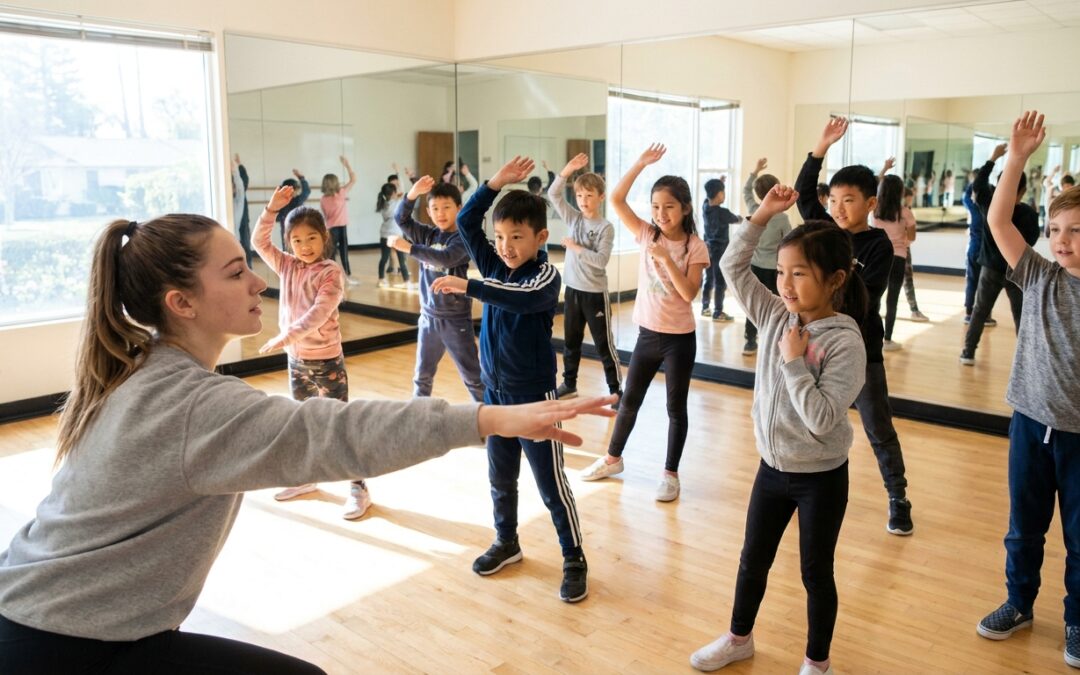
Most K-pop dance programs for children accept students starting at age 4 or 5. That is the general recommendation across SGV studios, and it aligns with where a child’s coordination, listening ability, and short-term memory are developed enough to follow group choreography. A few specifics:
- Ages 4-6: Focus on rhythm, simple movement phrases, and following a leader. Sessions are short and heavily repetitive.
- Ages 7-10: Ready for formations, arm-and-foot layering, and structured 60-minute group classes.
- Ages 11-18: Can handle faster tempos, more complex sequences, and performance-track preparation including on-camera and stage presence work.
One useful teaching note: for beginners of any age, the hardest part of K-pop choreography is not any single move. It is handling memory under load, keeping the sequence, the beat, the correct direction, and coordinated feet, arms, and torso active at the same time. A good class builds that skill gradually rather than front-loading a full routine on day one.
Is K-Pop Dance Age-Appropriate for Younger Kids?
Age-appropriateness in K-pop has two separate dimensions, and most studio marketing only addresses one of them. A class can be simplified in its dance steps yet still use songs, lyrics, or styling that are not suitable for a 6-year-old. Both elements require active instructor judgment.
- Choreography: Moves should match the child’s developmental stage. High-energy hip-hop isolations are fine; floor-based body rolls or adult-styled performance elements are not appropriate for young kids.
- Music: Instructors should screen song lyrics and themes, not just tempo. Popular idol tracks vary widely in content, and a rigorous program uses clean edits or selects tracks appropriate for the age group in the room.
- Styling: Recital or showcase costumes should reflect the child’s age, not replicate idol stage wear designed for adult performers.
The bottom line: beginner-friendly and age-appropriate are not the same thing. Ask your studio about both before you enroll.
How to Vet a Studio: Questions to Ask Before Enrolling
Before signing up for any K-pop program in Arcadia or the SGV, run through these questions at your studio tour or trial class. A quality program will have clear answers to all of them.
- How are songs and lyrics screened for the younger age groups?
- Is choreography adapted for developmental stage, or is it a scaled-down version of adult idol routines?
- Does the class teach foundational rhythm and movement before layering full choreography?
- How quickly is new choreography introduced, and what happens if a student falls behind?
- Are there performance, recital, or competition opportunities, and are they optional or expected?
- What is the class size, and how much individual correction does each student receive?
SGV K-Pop Dance Class Options Compared
Here is a side-by-side look at the main options SGV families consider, based on publicly available information.
| Studio | Location | Min. Age | Class Format | Pathway to Performance |
|---|---|---|---|---|
| Creation Talent Academy (CTA) | Arcadia, CA | 5 | KOD program: Hip-Hop, K-Pop, urban dance, choreography, performance training; after-school enrichment launching Fall 2026 | Recreational → Performance Track → Idol-Track Training |
| PopRock Academy | Temple City, CA | 5 | Group K-pop classes; teen and adult tracks available | Group performance; competition prep |
| Altadena Academy of Music & Arts | Altadena, CA | 4 | 60-min weekly group classes split by age and experience level | Recitals and themed showcases |
For families in Arcadia, Monrovia, or Pasadena, CTA’s location on South Baldwin Avenue is the most convenient option. Driving to Temple City or Altadena adds meaningful commute time for a weekly commitment.
What Separates a Hobby K-Pop Class from Pro Performance Training?
Most recreational K-pop classes teach a rotation of popular routines in a fun group setting. That is a great start for a 6-year-old. But it is not the same as performance-track training, and parents planning ahead should understand the difference.
| Element | Recreational K-Pop Class | Performance / Pro Training |
|---|---|---|
| Choreography source | Popular idol covers | Original + idol covers with technique emphasis |
| Formations | Basic group spacing | Structured formation changes, synchronization drills |
| Stage/camera presence | Rarely taught explicitly | Facial expression, eyeline, on-camera performance |
| Corrections | Group-level | Individual technique feedback each session |
| Competition/audition prep | Optional showcase | Structured pathway to competition and industry auditions |
Creation Talent Academy’s partnership with KOD, the KOD Dance Program launching at CTA Arcadia this Fall 2026, is built specifically around that second column. KOD (Keep On Dancing) has operated since 2004 as one of the world’s most recognized street dance events and cultural platforms. The program at CTA brings professional Hip-Hop, K-Pop, and urban dance training to Arcadia under that framework, covering choreography, performance training, and artistic development for elementary-age students, with the broader CTA curriculum extending through age 18.
What About Shy Kids or Complete Beginners?
This concern comes up constantly at SGV studios, and it is worth addressing directly. K-pop group classes are among the more beginner-accessible dance formats precisely because the group dynamic reduces individual spotlight pressure. A few practical notes:
- Beginner classes should start with short phrases repeated many times, not a full routine on week one. If a trial class overwhelms a new student with material, that is a pacing problem, not a problem with your child.
- Shy kids often respond well to the collective structure of K-pop choreography. Everyone is doing the same thing at the same time. The group becomes the comfort zone.
- Look for a class with a consistent roster rather than open drop-in format for younger beginners. Familiar peers and a predictable environment accelerate comfort significantly.
- A free trial class is the single best way to assess fit. CTA offers a free first trial class so students can experience the environment before committing.
The SGV Progression Path: From First Class to Performance Team
Parents who think beyond the first semester benefit from choosing a studio with a visible pathway, not just a single class offering. Here is how a structured progression looks at a full-service program:
- Entry (ages 5-7): Recreational K-pop group class. Rhythm, basic moves, listening, teamwork. Once per week, ~60 minutes.
- Intermediate (ages 8-12): Layered choreography, formation work, first recital or showcase performance.
- Performance track (ages 10-15): Competition prep, synchronization, stage and camera presence training.
- Idol track (ages 13-18): Audition preparation, original performance work, industry-facing training. CTA’s own alumni include Mystic Inscho, whose path from CTA to the global idol stage illustrates what this track can produce.
Not every student will pursue the idol track, and that is completely fine. The point is to choose a studio where the next level exists when your child is ready for it.
Common Mistakes to Avoid
- Assuming age-appropriate means beginner-friendly. A simplified routine can still use music or styling that is not right for a 7-year-old. Ask about both separately.
- Skipping the trial class. Studio marketing looks similar across options. In-person feel, instructor communication style, and class pacing differ significantly.
- Choosing only on proximity to a big-name idol group. “We teach BTS choreography” is not a curriculum. Ask what foundational technique is taught alongside the covers.
- Waiting until a child is “ready.” Age 5 is an appropriate starting point. Waiting until 10 because a child seems shy removes years of coordination-building and confidence development.
- Ignoring the performance pathway. If your child takes to dance seriously, you will want a studio with recitals, competition options, and advanced tracks already in place. Transferring between studios mid-progress costs time and momentum.
Frequently Asked Questions
What age can kids start K-pop dance classes in the San Gabriel Valley?
Most SGV K-pop dance programs accept students from age 4 or 5. CTA’s programs serve students ages 5 through 18. Starting earlier builds a longer foundation in coordination, rhythm, and performance confidence before the more technically demanding teen-level choreography.
Is K-pop dance appropriate for young children?
Yes, when taught by instructors who actively screen music, adapt choreography to developmental stage, and avoid adult-styled movements or costumes for younger students. Age-appropriateness requires deliberate instructor choices on both the movement and the music side. Ask your studio how they handle this before enrolling.
Does my child need dance experience to join a K-pop class?
No. Beginner-level K-pop classes are designed for zero prior experience. The key is that the class starts with fundamentals, introduces choreography in small pieces, and gives students time to repeat and internalize each section before adding more. If a studio rushes beginners through full routines, that is a red flag regardless of K-pop content.
What is the difference between a K-pop class and hip-hop dance?
K-pop choreography draws heavily from hip-hop, but it also incorporates popping, locking, jazz, and contemporary elements. K-pop classes typically organize around learning specific idol-group routines, while pure hip-hop classes focus more on foundational street-dance technique. Many strong urban dance programs teach both, as CTA’s KOD program does.
How do I enroll my child in K-pop dance classes in Arcadia?
Creation Talent Academy offers a free first trial class and is currently accepting Fall 2026 priority enrollment for the KOD Dance Program at its Arcadia location. Contact CTA directly to confirm which class level is the right starting point for your child’s age and experience.