
How Often Should Kids Practice Performing Arts at Home?
For most children enrolled in performing arts classes, 3 to 4 short sessions per week, not one long weekend block, is the sweet spot. The exact minutes depend on age and discipline, but the pattern is consistent across dance, acting, and vocal training: frequent, focused repetition builds muscle memory and confidence far faster than occasional cramming.
What Are the Right Practice Minutes by Age and Discipline?
Use the table below as your starting framework. These are home-practice targets on top of class time, calibrated for students in Arcadia and the San Gabriel Valley juggling school, homework, and extracurriculars.
| Age Group | Dance | Acting / Theatre | Vocal / Idol-Track | Sessions per Week |
|---|---|---|---|---|
| Ages 3–6 (Beginner) | 10–15 min (free movement, music listening) | Imaginative play, storytime re-enactment | Sing along in the car, humming | 3–4 informal |
| Ages 7–10 (Elementary) | 15–20 min (routine review, mirror work) | 15–20 min (line memorization, character questions) | 15–20 min (warm-up + song section) | 3–4 focused |
| Ages 11–14 (Pre-Teen) | 20–30 min (clean technique, full run-through) | 20–25 min (monologue reps, cold reading) | 20–30 min (warm-up + breath work + song) | 4–5 focused |
| Ages 15+ (Teen / Audition Prep) | 30–45 min (performance polish, self-recording) | 30+ min (self-tape reps, script analysis) | 30–45 min (full vocal workout, repertoire) | 5–6 targeted |
Very young beginners’ “practice” is mostly informal. Listening to class music in the car, singing along, or moving around the living room counts. Structured seat-time drills are not appropriate for 3- to 5-year-olds and can make performing arts feel like a chore before it has a chance to feel like joy.
How Does Home Practice Differ by Discipline?
Most guides cover only one art form. Students at a multi-track academy need a different approach for each discipline they study.
Dance: Movement, Mirror, and Music
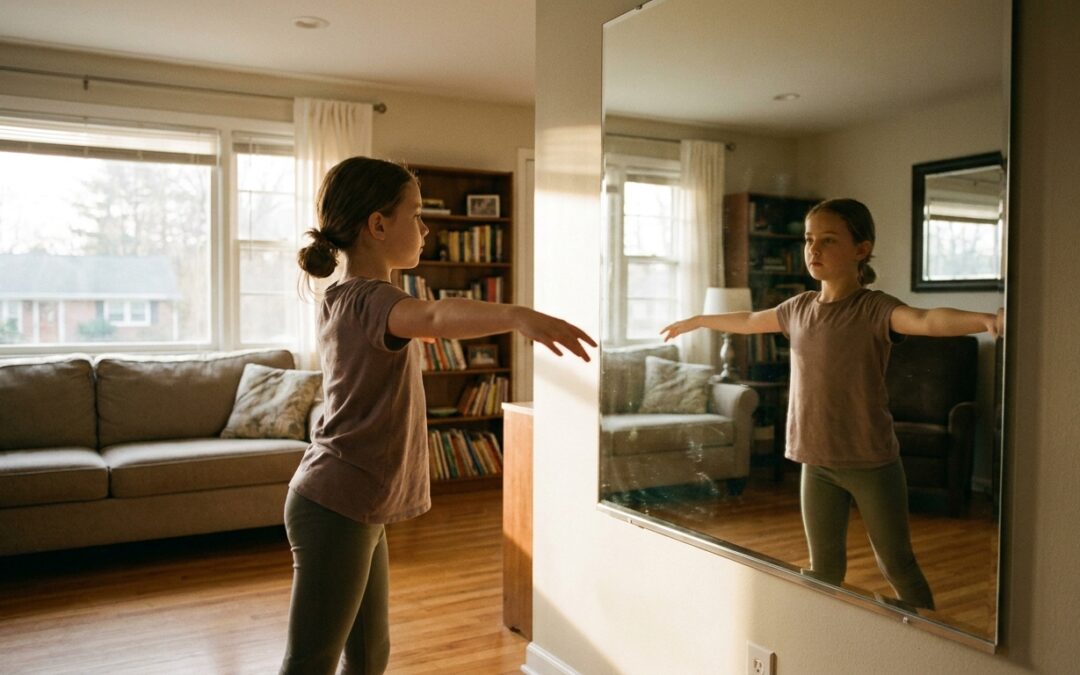
Clear a small space, add a mirror if possible, and play the class music. The goal is routine review, not a full performance run-through. Ask your child to walk through one section they found tricky in class, then let them choose what to polish. Recording a short clip on a phone so they can self-review is far more useful than a parent watching and correcting. Avoid forcing full run-throughs every session; that turns practice into a performance and raises anxiety rather than building confidence. If your child is just starting out and you are comparing styles, our guide on which dance style to start with for kids in Arcadia can help you understand what each class will ask of your child at home.
Acting / Theatre: Lines, Characters, and Self-Tape
Acting “practice” is the most misunderstood of the three. Parents often skip it because there is no obvious instrument to pick up. In reality, actors have concrete at-home tasks. For younger students, these include reading lines aloud three to five times, answering character questions (“What does my character want in this scene?”), and doing short improv games with a sibling or parent. For teens in audition prep, self-tape repetitions are the most valuable session format, record a monologue, watch it once for specific notes, re-record. Do not watch every take; one review pass per session is enough.
Vocal / Idol-Track: Warm Up Before You Sing
Idol-track and K-pop vocal students carry an extra responsibility: vocal health. Home practice should never start cold. A 3- to 5-minute warm-up (lip trills, gentle sirens, breath exercises) protects the voice and primes better tone. Breath support comes from the diaphragm, not the throat, and this is the one technical habit parents can gently reinforce without becoming a coach. Do not let students practice for more than 30 to 45 minutes at a stretch at home; overuse causes strain, especially during puberty. Our deeper breakdown of at-home habits for K-pop vocal training for kids in the San Gabriel Valley covers safe warm-up sequences in more detail.
When Should Your Child Practice More? A Trigger-Based Guide
Baseline practice minutes apply during regular training weeks. When a real event is coming up, increase frequency and specificity, but not duration. More sessions, not longer sessions, is the right adjustment.
| Upcoming Event | How to Adjust | How Far Out to Start |
|---|---|---|
| First recital or showcase | Add 1 extra session/week; focus on the performance piece only | 3–4 weeks before |
| Competition or dance-team audition | Add daily short sessions; record and review once per session | 4–6 weeks before |
| Acting or musical theater audition | Daily monologue/song reps; self-tape at least 2x per week | 2–4 weeks before |
| Summer intensive enrollment | Increase conditioning sessions; review prior-term material | 4 weeks before start date |
Practice gains clear purpose when it is tied to something real. Students who are preparing for a recital, a competition, or an audition engage more deeply and retain material faster than students practicing in the abstract.
What Is the Parent’s Role During Home Practice?
Your most valuable contribution is calm structure, not coaching. The single best question to open any practice session: “What did your teacher ask you to work on this week?” That one question returns ownership of practice to your child, which is where it belongs. After that, step back.
When you do give feedback, make it effort-based and specific. “You started again after that tricky turn instead of stopping” teaches your child to hear their own progress. Generic praise like “great job” gives them nothing to build on. A predictable practice window, after school before screen time, or right after dinner, removes the daily negotiation. The specific time matters less than the fact that it is the same time each day.
Avoid turning every session into a family performance. Running through the recital piece for grandparents every day before the show raises anxiety. Let the real performance be the performance.
Common Mistakes to Avoid
- One long session instead of several short ones. Two hours on Sunday with nothing midweek is far less effective than four 15-minute sessions spread across the week.
- Starting vocal practice cold. Singing without a warm-up stresses the vocal cords, especially for young idol-track students. Always warm up first.
- Skipping acting practice entirely. Lines, character work, and monologue reps are real tasks. Treating acting as the discipline that “doesn’t need homework” creates gaps in readiness.
- Coaching instead of supporting. Correcting technique is the teacher’s job. Your job is to hold the schedule and keep the energy positive.
- Forcing full run-throughs for young dancers. Repetitive full-routine runs before a recital can make younger kids dread the song. Work sections, not whole pieces.
- Over-practicing vocal parts without rest. Teen and pre-teen voices are still developing. Cap home singing sessions and schedule vocal rest days, especially around performances.
How Do You Set Up a Home Practice Space?
You do not need a dedicated studio. For dance, clear a 6-by-6-foot area of floor, place a full-length mirror on one wall if possible, and have a Bluetooth speaker ready with the class playlist. For acting, a quiet corner with good phone camera placement is enough for self-tape work, our step-by-step guide on filming your child’s self-tape audition at home walks through lighting, framing, and file format in detail. For vocal, a quiet room with no reverb (not a tiled bathroom, which gives false feedback on pitch) and a simple recording app on a phone is all that is needed.
Frequently Asked Questions
How many days per week should my child practice performing arts at home?
Three to four sessions per week is the recommended baseline for most elementary-aged students. Younger beginners can keep it to informal daily exposure, music in the car, free movement at home. Teens in audition or competition prep should aim for five to six focused sessions per week.
Is 15 minutes of home practice really enough?
Yes, for younger students. Fifteen focused minutes four times a week is more effective than a single 60-minute session, because repetition spaced across multiple days builds stronger memory retention. As students advance and approach auditions or competitions, sessions naturally lengthen to 30 to 45 minutes.
My child takes dance, acting, and vocal classes. Do they practice all three every day?
No. Rotate disciplines across the week based on what is coming up. If a recital is three weeks away, weight dance sessions more heavily. If an audition is approaching, front-load acting and vocal sessions that week. The total weekly practice time should stay manageable, burnout is a real risk for multi-track students.
Should I correct my child’s technique during home practice?
No. Technique correction is the instructor’s job, and well-intentioned parent corrections can introduce confusion and erode confidence. Your role is to hold the practice schedule, keep the environment positive, and ask the teacher what specific thing your child should focus on that week.
How do I keep home practice from turning into a battle?
Set a predictable time slot and keep sessions short. Tie practice to a real upcoming event so your child has a reason to care. Start each session with your child’s own words from class, “What did your teacher ask you to work on?”, and let them lead. When they feel ownership, resistance drops significantly.