
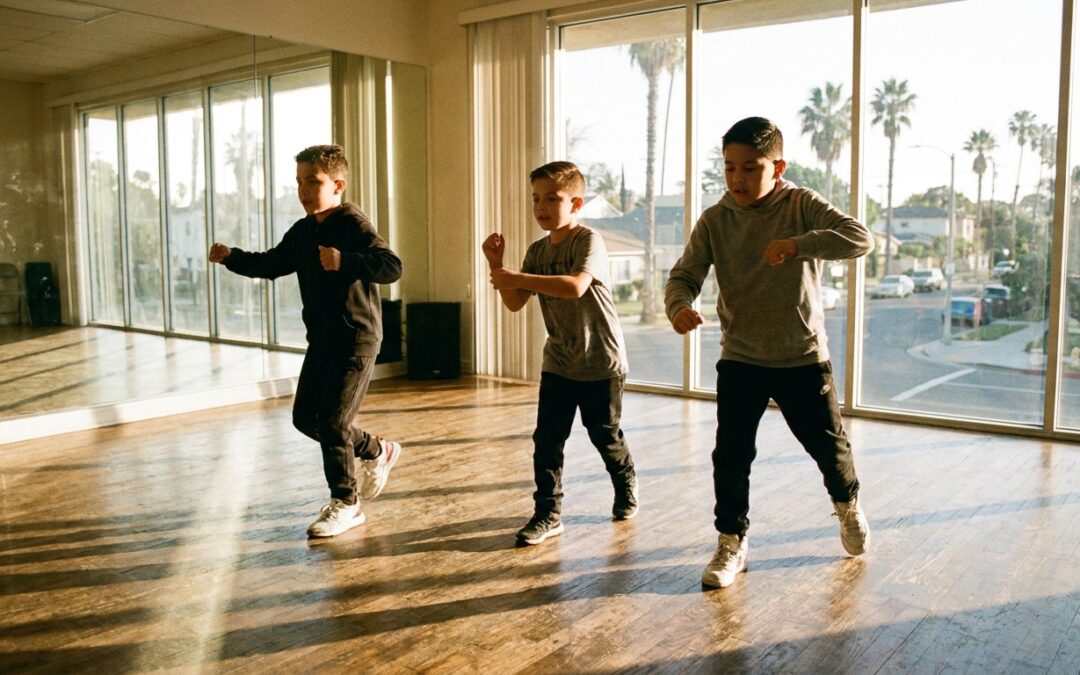
What Do Boys Actually Gain from Dance Classes in Arcadia?
Boys dance classes in Arcadia are not a niche activity, they are structured athletic training that pays dividends on the field, in the classroom, and on stage. If your son already plays soccer, basketball, or baseball in the San Gabriel Valley, dance is one of the highest-return cross-training tools available to him.
- Coordination and body control: Dance trains the body to move in multiple planes simultaneously, building spatial awareness that translates directly to sports like basketball and soccer.
- Core and leg strength: Controlled jumps, turns, and floor sequences develop the same muscle groups targeted in athletic strength programs, without the repetitive-impact risk of contact sports.
- Injury prevention: Dance emphasizes flexibility and proper alignment. Boys who dance regularly are less prone to the hamstring pulls and groin strains that sideline young athletes in football and baseball.
- Rhythm and musicality: Timing, understanding beats, anticipating cues, reacting to rhythm, sharpens the same mental processing athletes need to read a play or a pitch.
- Confidence and discipline: Performing choreography in front of peers and audiences builds the kind of composed, repeatable confidence that coaches and college admissions officers notice.
Notable professional athletes have quietly leaned on dance for exactly these reasons. Herschel Walker once said he never found a better cardio-endurance workout than his dance classes, and that framing tends to land well with skeptical dads in the SGV.
Should My Son Take Dance Classes? Addressing the Stigma Honestly
Yes, and the research backs it up clearly. The real barrier is not your son’s interest; it is usually the social environment around him. Prof. Doug Risner of Wayne State University, whose book Stigma and Perseverance in the Lives of Boys Who Dance is the definitive academic study on the subject, found that only about 32% of surveyed male dancers believed their fathers supported their dancing. That single data point explains most of the dropout patterns educators see.
Boys commonly pull back from dance classes around age seven, when self-consciousness about being “the only boy” peaks and peer teasing becomes a real social force. Studios and parents who plan around this window, by choosing environments where other boys are present and by being visibly enthusiastic supporters, dramatically improve retention.
The SGV demographic context matters here too. K-pop, streetwear culture, and hip-hop are deeply embedded in the communities stretching from Arcadia to Monrovia to Pasadena. Boys in this region have cultural permission, through those lenses, to engage with dance as something athletic and cool rather than something to be embarrassed about. That is a genuine local advantage parents can use.
Which Dance Styles Are Best for Boys Near Arcadia?
Not every style carries the same entry-barrier for boys. Here is a practical comparison of the three most boy-accessible options offered at studios in the Arcadia and San Gabriel Valley area:
| Style | Best For | Athletic Emphasis | Stigma Level | SGV/K-Pop Connection |
|---|---|---|---|---|
| Hip-Hop / Street Dance | Ages 6+, sports-minded boys, beginners | Power, agility, footwork | Low, widely seen as cool | Strong (breakdancing, freestyle) |
| K-Pop Dance | Ages 8+, boys who follow K-pop groups | Coordination, team sync, endurance | Low in SGV’s Korean-influenced culture | Very strong, the style itself is the hook |
| Ballet / Classical | Ages 5+, serious athletes seeking technique | Core, balance, flexibility, strength | Higher, requires a supportive studio | Moderate (foundation for all styles) |
| Jazz / Musical Theater | Ages 7+, boys interested in performance | Flexibility, stage presence | Low to moderate | Moderate (used in idol training) |
Hip-hop and street dance are the most accessible entry points for most boys in Arcadia and the wider SGV. The style reads as athletic, the music is familiar, and the learning curve does not require specialized footwear or a uniform that boys find awkward. For a first class, this is almost always the right call.
K-pop dance is the fastest-growing on-ramp for boys in this region specifically. The SGV has one of the largest Korean-American populations in the country, and K-pop fandom spans all ethnicities here. Group choreography from artists like BTS or Stray Kids is aspirational content for boys in Arcadia, Pasadena, and Monrovia. If your son watches those videos and tries to copy the moves in the living room, a K-pop dance class in the SGV is the obvious next step.
Ballet deserves a mention beyond the stigma conversation. Boys who commit to ballet, even briefly, build a physical foundation that accelerates progress in every other style. The core strength, turnout, and spatial precision are unmatched. Boys in football or basketball academies who add even one ballet class per week see measurable improvement in balance and injury prevention. The key is finding a studio with male teachers or at least a visible cohort of other boys in the room.
How Do I Find a Dance Studio That Is Actually Welcoming to Boys in the San Gabriel Valley?
The Yelp and ClassPass directories that dominate local search results for “dance classes near me Arcadia” give you star ratings but no information about whether your son will feel comfortable and stay enrolled. Use this checklist when you call or visit a studio:
- Male instructors or male guest teachers: Seeing a man dance with skill and authority is one of the most powerful normalizing signals a boy can receive. Ask directly whether the studio employs any male faculty.
- Other boys currently enrolled: Ask for the rough boy-to-girl ratio in the class you are considering. Even two or three other boys in a class of twelve changes the social dynamic completely.
- No-audition intro classes: A studio confident in its boy-friendly environment will let your son try a class without committing. Reluctance to offer a trial is a yellow flag.
- Flexible dress codes: Boys should not be required to wear tights or gear that feels alienating in their first month. Good studios allow athletic shorts and a T-shirt for beginners.
- Anti-bullying culture: Ask how the studio handles teasing or exclusion. Studios that have thought about this question will have a real answer ready.
- Age-grouped classes: A 9-year-old boy in a class full of 12-year-old girls is likely to quit by week four. Make sure the age bracketing is tight.
Some studios nationally run explicit boy-recruitment programs, free introductory tuition, male mentorship tracks, or “boys-only” class sections. When comparing studios in Arcadia, Pasadena, and Monrovia, ask whether any such program exists, even informally. It signals that the studio has thought beyond its default enrollment.
What About the “My Son Will Be the Only Boy” Worry?
This is the most common concern parents raise, and it is also the most actionable one. Here is the honest picture: in many beginner recreational classes at small studios, your son may be in the minority. That is the current reality of most dance enrollment in the US. But minority does not mean alone, and it certainly does not mean unwelcome.
The critical age window is roughly 6 to 10 years old. Boys who start dancing before the self-consciousness of middle school sets in, and who have at least one other boy alongside them, are far more likely to build a lasting relationship with dance. Parental attitude during this window is the decisive variable. Dance educators consistently point out that when a dad shows up to recitals, asks about class, and treats dance with the same seriousness as a soccer match, boys stay enrolled.
Programs modeled after initiatives like Ballet Jörgen’s “Boys Who Dance” mentorship, which pairs young male dancers with adult male mentors and creates open forums to discuss bullying and technique, show that structural support works. When vetting studios near Arcadia, ask whether they have any equivalent program or whether the teaching staff actively addresses the experience of being a boy in dance.
Dance vs. Traditional Sports: A Comparison for SGV Families
| Factor | Youth Dance | Contact Sports (Football, Hockey) |
|---|---|---|
| Injury risk | Lower, no collision impact, controlled environment | Higher, concussion and orthopedic risk well-documented |
| Core/flexibility development | Very high, built into every class | Moderate, often supplemental, not primary |
| Coordination gains | Very high, multi-planar movement every session | Moderate, sport-specific movement only |
| Year-round availability | Yes, fall, spring, and summer programs in Arcadia | Seasonal for most youth leagues |
| Team / social skills | High, ensemble choreography, recitals, showcases | High, team sports format |
| Mental discipline | Very high, memorization, performance under pressure | High, strategy, resilience |
| K-pop / entertainment pathways | Direct, idol training, audition prep, showcases | None |
Dance is not a replacement for sports, it is an upgrade to the athletic foundation underneath them. Boys who add even one dance class per week alongside their sport-specific training typically see measurable gains in agility, spatial awareness, and injury resilience within a single season.
Common Mistakes to Avoid
- Waiting until your son “asks” for dance classes. Boys socialized to see dance as “not for them” rarely self-initiate. A parent who frames a trial class as athletic training removes that barrier entirely.
- Choosing a studio solely by proximity. The nearest studio may not be the most boy-welcoming. Drive the extra ten minutes to Pasadena or Monrovia if that studio has a better male enrollment and more experienced teachers.
- Enrolling and then not showing up to watch. Parental presence at classes, recitals, and showcases is the single most documented retention factor for boys in dance. Showing up matters more than almost anything else.
- Starting with ballet if your son is stigma-sensitive. Hip-hop or K-pop is almost always a lower-friction entry point. Ballet can follow once your son is confident and committed.
- Ignoring the age-grouping when registering. A boy placed in the wrong age band, especially one where he is noticeably younger or the only male, is likely to quit within the first month.
- Treating quitting as inevitable. The dropout risk around age 7 is real but not destiny. Addressing it proactively, choosing the right studio, attending consistently, and talking openly about the experience, keeps most boys enrolled through the critical window.
Frequently Asked Questions
What age should my son start dance classes in Arcadia?
Most studios in the Arcadia and San Gabriel Valley area accept boys starting at age 3 to 5 for creative movement or pre-ballet, and age 6 to 7 for structured hip-hop or jazz beginner classes. Starting before age 7 is ideal because it precedes the self-consciousness window that causes many boys to disengage. That said, boys who start at 10 or 12 with no prior experience can absolutely thrive, especially in hip-hop and K-pop formats where raw enthusiasm matters as much as technical foundation.
Will my son be the only boy in a dance class near me in the SGV?
In many beginner recreational classes at smaller studios, boys are in the minority, this is true across the US, not just the San Gabriel Valley. However, hip-hop and K-pop classes in the SGV tend to attract a more balanced gender mix because the styles carry less stigma. When you call a studio, ask directly how many boys are currently enrolled in the class you are considering. A studio with zero boys in that slot should prompt you to ask why before you commit.
Is hip-hop dance a good starting style for boys in Arcadia?
Yes, hip-hop and street dance are the most accessible and stigma-free entry points for most boys. The style is athletic, the music is familiar, and the dress code is casual. For a first class, hip-hop removes almost every barrier that causes boys to resist dance. Once your son is comfortable and confident, adding a K-pop or jazz class alongside it builds range without requiring a major identity shift.
Can dance classes help my son perform better in team sports?
Yes, consistently. Dance builds coordination, core strength, flexibility, and multi-directional agility, physical qualities that translate directly to basketball, soccer, baseball, and football. Boys who cross-train with dance use muscles differently than standard sports practice requires, which helps prevent overuse injuries and builds new movement patterns. Several NFL and professional athletes have credited dance training with extending their careers and improving their performance.
How do I know if a studio near Arcadia is genuinely welcoming to boys?
Ask five questions: Does the studio employ any male instructors? How many boys are currently enrolled in the class you are considering? Can your son try one class before committing? Is the dress code flexible for beginners? How does the studio handle teasing or social pressure among students? A studio that gives confident, specific answers to all five is the one worth your son’s time and your family’s investment.
If your son is ready to try his first class, or if you want to see exactly what a boy-welcoming, multi-style training environment looks like in person, Creation Talent Academy in Arcadia offers hip-hop, K-pop, and performing arts training designed for kids across the San Gabriel Valley. You can also explore our dance audition prep programs if your son has his sights on a competition team or performance showcase down the road.