What Is a Kids K-Pop Dance Class, and What Should It Actually Do?
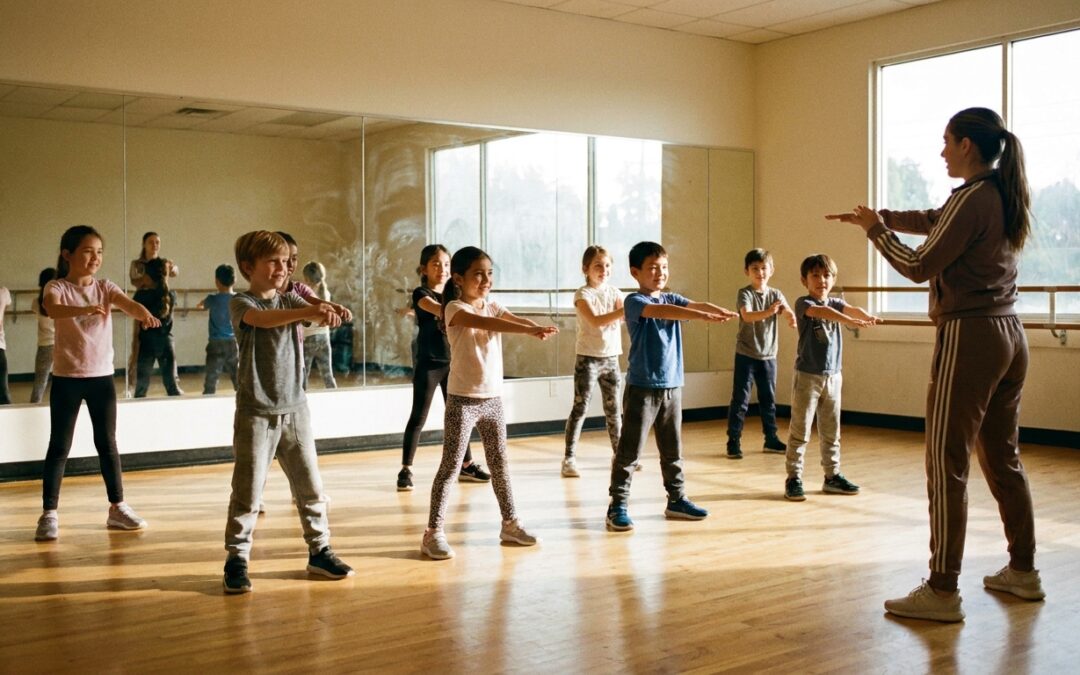
A kids kpop dance class in Arcadia teaches youth the synchronized group choreography that defines K-pop performance: sharp isolations, formation changes, and rhythmic footwork set to the style of artists like NewJeans, aespa, or Stray Kids. A well-run class for children also builds coordination, listening skills, musicality, and stage confidence, skills that transfer well beyond the dance floor. If a class is doing its job, your child comes home sweaty, happy, and asking when the next session is.
What it should not be is a copy-paste of idol-industry training. Understanding that distinction is the single most useful thing an SGV parent can do before enrollment.
What Age Can My Child Start K-Pop Dance in the San Gabriel Valley?
Most local studios in the Arcadia, Monrovia, and San Gabriel area group K-pop classes starting around ages 5 to 6 for their youngest cohort, with separate tracks for older kids and teens up through age 18. Many SGV programs offer classes once a week for 60 to 75 minutes, grouped by both age and experience level so a brand-new 7-year-old is not in the same room as a 15-year-old who has been training for four years.
At Creation Talent Academy in Arcadia, youth programming runs from ages 5 through 18, making it one of the broadest age ranges offered under one roof in the 626. Younger students (ages 5 to 8) focus on rhythm, basic groove, and short phrase learning. Students ages 9 to 13 are ready for full-song breakdowns and small-group formations. Teens 14 and up can handle the layered technique, performance detail, and stage-presence work that sits at the core of a real idol-track pathway.
The short answer: if your child can follow a multi-step instruction, move safely in a group, and handle a 60-minute class without melting down, they are ready to try. For most kids, that’s somewhere between 5 and 7.
Recreational vs. Performance vs. Idol-Track: Which Class Type Fits Your Child?
This is the question no local competitor’s website actually answers, and it’s the one that matters most for both the right fit and the right expectations.
| Class Type | What It Covers | Best For | Typical Commitment |
|---|---|---|---|
| Recreational | K-pop choreography, basic groove, music exposure, fun group energy | First-time dancers, kids who love K-pop casually, ages 5–10 | Once a week, one class style |
| Performance / Competition | Polished full routines, stage formations, crew dynamics, showcase or competition prep | Kids with 1+ years of dance, who want a recital or competition goal | Once or twice a week, showcase commitments |
| Idol-Track / Integrated | Dance + vocal training + stage presence + acting fundamentals under one program | Motivated teens (and some tweens) who want the full performance artist development | Multiple disciplines per week, performance milestones |
The recreational track is where most kids in the SGV begin. It is low-pressure, high-energy, and a great way to find out whether your child actually wants to commit before you invest in costumes and competition fees.
The idol-track model is something different entirely, and what makes Creation Talent Academy unusual in the San Gabriel Valley is that it offers all three pathways under one Arcadia roof. A child can start recreational at age 6, move into performance crew work at 10, and step into an integrated dance, vocal, and acting program in their teen years without switching studios or rebuilding relationships with instructors. CTA’s partnership with KOD (Kultur of Dance) adds a professional Hip-Hop and K-Pop/urban dance program launching Fall 2026, with priority enrollment currently open, a direct upgrade for students ready to train at a higher level right here in Arcadia.
Is K-Pop Dance Good for Kids? What the Research Says
Yes, with the right class structure. K-pop choreography demands coordination, muscle memory, spatial awareness, and endurance, all in a group setting that requires students to synchronize with their peers. That combination builds both physical and social skills simultaneously. Specific documented benefits include:
- Coordination and body awareness: Learning to isolate specific muscle groups (the chest pop, the arm wave, the footwork snap) builds motor control that carries over into sports and everyday movement.
- Memory and focus: Retaining 8-count phrases and linking them into a full routine is an active cognitive exercise. Kids who struggle to sit still in school often thrive here.
- Teamwork: K-pop group choreography means your timing affects everyone else on the floor. Kids learn accountability without a lecture about it.
- Cardiovascular fitness: A full-song K-pop routine runs 3 to 4 minutes of near-continuous movement. Repeat it five times in class and you have a real workout.
- Confidence: Performing in a showcase, even a small studio recital, is a confidence milestone that many students describe as transformative.
One note that every parent in the SGV should carry: beginner-friendly does not automatically mean age-appropriate. Parents often hear “beginner friendly” and assume that means “appropriate for kids”, but those are not the same thing. A class can simplify steps and still use music, themes, or styling that don’t fit younger students well. Ask how instructors screen their song and video selections before your child’s first class.
Why the Korean Idol Trainee System Is Not the Model Here, and Why That’s Good News
When SGV parents search “idol training for kids Los Angeles,” some of the results they find describe South Korea’s professional trainee system. That context is worth understanding so you can set realistic, healthy expectations.
South Korea’s trainee system has faced long-standing issues regarding trainee rights and working conditions, with juvenile trainees particularly vulnerable to educational disruption and unsafe conditions. Revisions to standard contracts that took effect on January 1, 2026, seek to improve compensation transparency, expand mental health protections, and strengthen safeguards for young performers, a signal that even South Korea acknowledges the system needed significant reform. Trainees now enter the Korean system at pre-teen ages, with training that ranges from acting and language learning to daily monitoring of media use and the detailed management of physical appearance.
None of that is what a healthy local idol-track program in Arcadia looks like. The CTA model keeps students in school, at home with their families, and on a gradual skills progression that fits their age and developmental stage. The goal is performance skills and artistic confidence, not a debut contract. That reframing matters: a child who trains locally through their teen years accumulates real skills (dance, vocal, stage presence, acting) that open doors to school musicals, regional competitions, professional auditions, and college performance programs. CTA alumna Mystic Inscho is a concrete local example of what that pathway produces. Read about Mystic’s journey from CTA Arcadia to Disney’s The Mysterious Benedict Society and School of Rock on Broadway to understand the kind of trajectory local training can actually support.
How to Compare K-Pop Dance Studios in the San Gabriel Valley
Arcadia and the surrounding 626, Monrovia, Pasadena, San Gabriel, Temple City, have multiple studios offering K-pop classes for kids. Here is a practical comparison framework so you know what you are actually evaluating.
| What to Compare | What a Strong Program Offers | Red Flag |
|---|---|---|
| Age grouping | Separate classes by age band (e.g., 5–8, 9–12, 13–18) AND experience level | All ages and levels in one room |
| Music/video screening | Instructor can explain exactly how songs are chosen for younger classes | Vague answer or “we use whatever’s popular” |
| Class length and frequency | 60–75 min once a week for beginners; option to add classes as skill grows | No clear schedule or mandatory multi-class packages from day one |
| Showcase/recital opportunities | At least one annual performance milestone; competition pathway optional, not required | Zero performance opportunities, or mandatory costly competitions |
| Instructor credentials | Dance training in hip-hop, K-pop, or urban styles; experience with youth | No credentials listed, or adult-only teaching background |
| Pathway flexibility | Can move from recreational to performance to multi-discipline without changing studios | One-size class, no visible progression ladder |
| Inclusive programming | SDP or adaptive services available for students with special needs | No mention of inclusive options |
Creation Talent Academy checks each of these boxes, including SDP services for special-needs students, a differentiator rarely advertised by other SGV studios. The Fall 2026 KOD program adds a professional-caliber urban/K-pop dance track that no other local studio currently offers.
Questions to Ask Before Enrolling in Any Arcadia or SGV K-Pop Dance Class
Bring these to any studio tour or trial class, whether at CTA or elsewhere in the 626:
- How do you screen song and video choices for my child’s age group? A quality instructor can answer this specifically, not just say “we keep it appropriate.”
- Are classes grouped by age AND experience level? Both matter. A 9-year-old beginner and a 9-year-old with three years of hip-hop should not be in the same class.
- What does a typical class look like? Look for a warm-up, foundation drills, choreography breakdown in 8-count sections, and a full run-through, not a free-dance session.
- What is the showcase or performance schedule? A recital or studio showcase gives students a goal and a milestone. Ask how often and what the cost commitment is.
- Is there a trial class? Any studio confident in its teaching offers a trial. Use it to watch how the instructor corrects students and manages group energy.
- What happens if my child wants to add vocal or acting training later? If the answer is “you’d need to find that elsewhere,” you may be limiting your child’s development unnecessarily.
- Do you offer adaptive or SDP services? If your child has special needs, this is non-negotiable to ask upfront.
Common Mistakes to Avoid
- Choosing a class by song recognition alone. Just because the class is learning a BTS or BLACKPINK routine does not mean the content is screened for 7-year-olds.
- Skipping the trial class. Online reviews tell you about the studio experience; a trial class tells you about your child’s specific instructor and class dynamic.
- Enrolling in a performance-track class before your child is ready. Starting recreational and progressing into performance is the right sequence. Jumping straight to competition prep with a beginner often leads to frustration and dropout.
- Treating “idol training” as the goal for young kids. Building performance skills, confidence, and artistic range is the age-appropriate goal. The idol-industry pathway is a separate, demanding adult choice, one that even South Korea is actively reforming to protect minors.
- Overlooking logistics. A studio 40 minutes from Arcadia is only realistic if you have flexibility in your schedule. The SGV has strong local options; prioritize ones within a reasonable driving radius of your home in the 626.
- Not asking about multi-discipline pathways. If your child might eventually want dance plus vocals plus acting, a studio that only offers dance will require a disruptive switch later.
Frequently Asked Questions
What age should my child start a K-pop dance class in Arcadia?
Most SGV studios begin K-pop classes at ages 5 to 6 for their youngest group. The key readiness indicators are the ability to follow multi-step instructions, move safely in a group setting, and sustain focus for a 60-minute class. Creation Talent Academy accepts students from age 5 through 18, with class groupings matched to both age and experience level.
Does my child need prior dance experience for a beginner K-pop class?
No. A true beginner K-pop class starts with foundational groove, rhythm, and short movement phrases before progressing to longer choreography. Prior ballet or hip-hop experience helps, but it is not required. The important thing is that the class is actually structured for beginners, ask the studio what the first four weeks of class look like before enrolling.
How is a K-pop dance class different from an idol-track program?
A K-pop dance class focuses on choreography in a single discipline. An idol-track or integrated program combines dance with vocal training, stage presence coaching, and often acting fundamentals, the combination that real K-pop performers train across. CTA’s model in Arcadia offers both, so students can begin with dance and expand into a full multi-discipline track as they progress.
How do I know if a studio’s K-pop content is age-appropriate for my younger child?
Ask directly: “How do instructors choose songs and movement styles for the younger age groups?” A confident, specific answer, referencing lyric review, age-band class separation, and choreography modification, is a green flag. A vague answer is a signal to look elsewhere. Beginner-friendly and age-appropriate are two different things, and the best local studios in the SGV treat them that way.
Is Creation Talent Academy in Arcadia right for kids who are not sure they want a serious track?
Yes. CTA’s recreational classes are designed for kids who love K-pop and want to learn choreography in a fun, structured environment, no competition commitments required. The pathway exists to grow into a performance or idol track if a student’s passion grows, but nothing forces that step. A free trial class is the best way to see whether the environment, instructor, and class energy are the right fit for your child.