
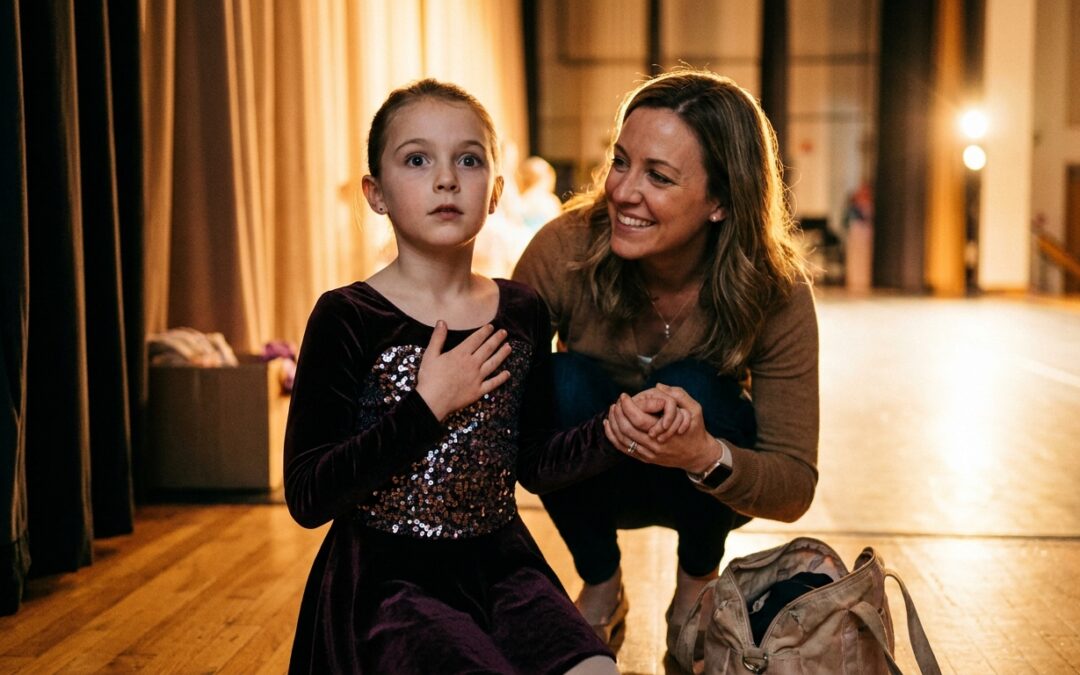
What Is Stage Fright in Kids, and Is It Normal?
Stage fright in kids is a physiological stress response, the same fight-or-flight mechanism that kept early humans safe, misfiring in a recital hall or audition room. It is completely normal, and it affects young dancers, actors, and singers alike. The goal is not to eliminate it but to give your child tools to work with it.
At Creation Talent Academy in Arcadia, our coaches work with students across the San Gabriel Valley every week who experience performance anxiety. The pattern we see consistently: nerves signal that a child cares about what they are doing. That caring is a strength, not a flaw.
Quick Answer: How to Help a Child Overcome Stage Fright
These six steps work across dance, acting, and singing disciplines. Each one is expanded in the sections below.
- Normalize the nerves. Tell your child butterflies mean they care, not that there is danger.
- Teach box breathing. Inhale 4 counts, hold 4, exhale 4, hold 4. Repeat four times before going on.
- Reframe nerves as excitement. “I’m excited” outperforms “I’m nervous”, physically and mentally.
- Build a pre-performance routine. Same warm-up steps every time creates a sense of control.
- Run mini-recitals at home. Perform for family first, then gradually expand the audience.
- Praise effort, not outcome. The courage to prepare and perform is the win.
How Does Stage Fright Show Up Differently by Discipline?
Most advice treats performance anxiety as one generic experience. It is not. A dancer’s nerves produce different failure points than an actor’s or a singer’s. Fixing the right thing for the right discipline matters.
| Discipline | Common Anxiety Symptom | What Is Actually Happening | Specific Fix |
|---|---|---|---|
| Dance | Blanking on choreography; losing spotting focus | Stress hormones temporarily impair short-term memory recall; eyes dart instead of anchoring | Mark the opening 8-count in the wings; lock a physical anchor (spot a fixed point on the back wall before stepping on) |
| Acting / Theatre | “Going up” (forgetting lines mid-scene) | The prefrontal cortex, which retrieves memorized text, goes partially offline under acute stress | Rehearse a physical “home base” action (a gesture or movement) tied to each scene beat so muscle memory carries the child through the blank |
| Singing / Vocal | Shaky breath, cracking voice, pitch drop | Shallow chest breathing and cortisol-driven throat tightness disrupt breath support and resonance | Three slow diaphragmatic breaths immediately before entrance; hum softly in the wings to warm and open the throat |
| On-camera / Self-tape auditions | Stiffness, over-monitoring of the lens, flat energy | The camera feels like heightened judgment; the child self-monitors instead of performing | Record casual, low-stakes takes at home weekly so the camera becomes familiar, not threatening (see our guide on how to film your child’s self-tape audition at home) |
Box Breathing: The 30-Second Tool Every SGV Performing Arts Parent Should Know
Box breathing is the single most research-supported technique for pulling a child’s nervous system out of fight-or-flight before a performance. The pattern: inhale for 4 counts, hold for 4, exhale for 4, hold for 4. Repeat the cycle four times. This activates the parasympathetic nervous system, the body’s “rest and digest” mode, and takes the edge off acute nerves without sedating the child’s energy.
For younger children (preschool through early elementary), use the “smell the flower, blow out the candle” cue instead of counting. Breathe in slowly through the nose as if smelling something wonderful, then exhale slowly through the mouth as if gently blowing out a birthday candle. Same physiology, more concrete for a five-year-old.
Practice this at home during non-performance moments so it becomes automatic. A child who has drilled box breathing 50 times in the living room will actually reach for it backstage. One who has only heard about it will not.
Why “Just Calm Down” Backfires, and What to Say Instead
Telling a child to calm down or “just get over it” worsens anxiety by adding a layer of shame: now the child is not only nervous, they believe something is wrong with them for being nervous. Research on anxiety reappraisal shows a more effective approach. Because anxiety and excitement produce nearly identical physiological states, elevated heart rate, butterflies, heightened alertness, the difference is largely the label the child puts on those sensations.
Coach your child to say “I’m excited” instead of “I’m nervous.” This is not toxic positivity; it is a real neurological shift. Studies by Harvard researcher Alison Wood Brooks found that this single reframe led to measurably better performance across high-pressure tasks. When kids treat their nerves as fuel rather than a warning sign, they stop fighting the feeling and start channeling it.
Phrases that help before a performance:
- “Those butterflies mean your body is getting ready. That’s a good thing.”
- “You have prepared for this. Trust what you know.”
- “Go out there and share what you love. That’s the whole job.”
Phrases to avoid right before a performance:
- “Don’t mess up.” (focuses attention on failure)
- “Are you nervous? You look nervous.” (amplifies anxiety)
- “Just relax.” (impossible instruction that adds pressure)
- “This is so important, you have to do well.” (raises perceived stakes)
Age-Banded Guide: Stage Fright by Developmental Stage
What works for a 16-year-old auditioning for an idol showcase is not what works for a six-year-old in her first recital. Match the strategy to the child’s age.
| Age Group | How Stage Fright Typically Presents | Most Effective Parent Response |
|---|---|---|
| Ages 4-6 (Preschool) | Clinging, crying, refusing to walk out, freezing on stage | Keep stakes ultra-low; celebrate any step onto the stage at all. Use “smell the flower, blow out the candle” breathing. Never force the child on; invite and encourage. |
| Ages 7-9 (Early Elementary) | Stomach aches on recital day, going blank mid-routine, visible shaking | Build a pre-performance ritual (same playlist, same stretch, same pep talk). Run two or three mini-recitals at home in the week before. Video a run-through and watch it together, pointing out what went right. |
| Ages 10-12 (Tween) | Heightened self-consciousness, comparison to peers, over-monitoring mistakes | Shift focus from self to audience: “What feeling do you want to give them?” Praise specific preparation choices, not just performance outcome. Role-reversal exercise: you “perform” imperfectly and keep going, showing mistakes are survivable. |
| Ages 13-18 (Teen) | Audition-specific dread, camera nerves during self-tapes, catastrophic thinking before competition | Box breathing plus a structured pre-performance routine they design themselves. Journal the post-performance “what went well” to build an internal evidence base. For idol-track or K-Pop vocal training students, normalize that live audition nerves and camera nerves require separate, deliberate practice. |
How the Studio Environment Itself Reduces Performance Anxiety
Parents in Arcadia and across the San Gabriel Valley often ask whether a child will “grow out of” stage fright. The answer depends heavily on what kind of performance environment the child trains in. A child who takes one big recital per year with 30 strangers watching is not building the same nervous-system tolerance as a child who performs regularly in small, safe, graduated settings.
At Creation Talent Academy, classes run with just 4 to 8 students. That ratio means instructors, all working industry professionals, can observe and coach the anxiety response directly, not just the technical skill. A child who visibly locks up during choreography gets a real-time cue from a coach who notices. A singer who breathes shallow under pressure gets a breath-support correction in the moment it happens.
The progression from class performance to studio showcase to outside audition or competition is intentional. Each step slightly raises the perceived stakes while keeping the child anchored in what they already know. That graduated exposure is exactly what research on anxiety tolerance recommends: not avoidance, not overwhelm, but a steady series of “wins” that build a child’s personal evidence base for “I can do this.”
Students enrolled in acting, dance, and vocal programs at CTA get this multi-discipline exposure, which means a child who is anxious about singing in public might build genuine confidence first through improv classes, where low-stakes spontaneity teaches the brain that going off-script is survivable, and even fun.
The Parent’s Own Anxiety: How It Transfers and How to Manage It
Children, especially younger ones, are exquisitely attuned to a parent’s emotional state. If you are visibly tense, rushing them, peppering them with last-minute reminders, or expressing your own pre-show anxiety, your child’s nervous system reads that as confirmation that something is threatening. Your calm is not a nice-to-have, it is part of the intervention.
Practical steps for managing your own pre-performance anxiety as a parent:
- Arrive early so logistics do not become a source of chaos.
- Do your own version of box breathing in the car on the way over.
- After drop-off, step back physically. Hovering signals distrust in the child’s readiness.
- Prepare your “after” response in advance: “I’m so proud of you for going out there”, regardless of how the performance goes.
- Do not debrief mistakes immediately after the show. Let the child feel the relief of completion first.
When Is Performance Anxiety More Than Stage Fright?
Most stage fright in kids is developmentally normal and responds to the strategies above. A few signs suggest it may be worth a conversation with your child’s pediatrician or a licensed therapist:
- The child refuses to attend class or rehearsal entirely, not just a single performance.
- Anxiety about performing is bleeding into other social settings (school presentations, social gatherings).
- Physical symptoms, vomiting, severe headaches, panic attacks, occur days before a performance, not just on the day.
- The child has not spoken in a particular social setting for an extended period (a possible indicator of selective mutism).
For families whose children have IEPs, 504 plans, or are enrolled through California’s Self-Determination Program, Creation Talent Academy offers SDP-compatible performing arts services. Structured, low-ratio, sensory-aware instruction reduces the unpredictability that often heightens anxiety for neurodivergent students. If this applies to your family, contact CTA directly to discuss how we can build an appropriate plan.
Build the Mini-Recital Habit at Home
The single most universally recommended tactic across performance psychology research is graduated exposure through “safe audience” rehearsal. The steps below work for dance, acting, and singing alike:
- Week before: Perform the full piece once for one parent, with no commentary during the run-through.
- Three days before: Add a sibling or second parent. Give the child a brief moment to reset before starting, just like backstage.
- Day before: Record the run-through and watch it together. Identify and name three things that went well. Do not lead with corrections.
- Day of: One final run of the opening section only, enough to feel grounded, not so much that the child peaks at home.
The role-reversal exercise is especially powerful with younger children: you “perform” something in front of them, make an obvious mistake, laugh it off, and keep going. Children absorb this modeling viscerally, it teaches that errors are survivable without a single word of explanation.
For more on at-home practice structures that build performance readiness without burning kids out, see our guide on how often kids should practice performing arts at home.
Common Mistakes to Avoid
- Telling a child to “calm down” right before they go on. This raises stakes and signals that their current emotional state is wrong.
- Over-rehearsing the piece on performance day. Last-minute drilling increases anxiety; a quick run of the opening is enough.
- Debriefing mistakes immediately after the show. Wait at least 24 hours before any technical feedback conversation.
- Skipping the mini-recital phase. Expecting a child to perform confidently for 200 people when their only full audience has been a mirror is unrealistic.
- Praising outcome over effort. “You were the best one up there” ties confidence to external comparison; “you worked hard and you went for it” builds internal resilience.
- Treating anxiety as a character flaw. Saying “why are you so nervous, just be confident” shames the child for a biological response they did not choose.
- Transmitting your own panic to the child. Rushing, over-reminding, or visibly stressing in the car or at drop-off raises the child’s arousal level before they even reach the wings.
Ready to Build Confidence on Real Stages Near Arcadia?
If your child is dealing with stage fright in kids performing arts settings, the most effective long-term solution is a studio environment that builds confidence deliberately, through small classes, graduated performance exposure, and coaches who know how to see and respond to anxiety in the moment.
Creation Talent Academy at 1229 S Baldwin Ave, Arcadia serves students ages 5-18 across the San Gabriel Valley, from Monrovia and Pasadena to El Monte and beyond, in dance, acting, and vocal training. Classes cap at 4-8 students. Instructors are working industry professionals. The path runs from first class to real stages, one safe step at a time.
Book a free trial class and let your child experience what low-pressure, high-support performing arts training feels like in person. For families considering multiple programs or wanting to understand the full range of after-school options, our after-school performing arts decision guide for Arcadia families walks through every option in the SGV.
Frequently Asked Questions
Is stage fright in kids the same as performance anxiety?
They are the same underlying experience: a physiological stress response triggered by performing in front of an audience. “Stage fright” is the everyday term; “performance anxiety” is the clinical framing. Both describe the racing heart, shallow breathing, and cognitive blanking that many children experience before dance recitals, acting performances, and singing showcases. Neither label means something is wrong with your child.
At what age do kids typically start experiencing stage fright?
Stage fright can appear as early as age four or five, often showing up as crying, clinging, or refusing to walk on stage. It tends to intensify in the tween years (ages 10-12) as self-consciousness increases. Teens who pursue competitive or audition-track training may experience a new form of nerves specific to camera auditions and agency evaluations. Each age band responds to different strategies, see the age table above.
What do I say to my child right before they go on stage?
Keep it short, calm, and effort-focused. “You’ve prepared for this, go share what you love” works well. Avoid raising stakes (“this is so important”), identifying their anxiety (“you look nervous”), or giving last-minute technique reminders. Your body language matters as much as your words: a slow exhale, a steady smile, and a relaxed posture communicate safety more effectively than any pep talk.
How is stage fright different for dancers, actors, and singers?
Dancers are most likely to blank on choreography or lose their spotting focus under stress. Actors tend to “go up”, forgetting lines mid-scene, because the prefrontal cortex that retrieves memorized text is partly suppressed by acute anxiety. Singers experience shallow breathing and throat tightness, which disrupts breath support and can cause pitch instability. Each discipline needs its own targeted fix, not generic “just breathe” advice.
When should I be concerned that my child’s stage fright is more than normal nerves?
Talk to your child’s pediatrician if the anxiety leads to complete class or rehearsal avoidance (not just pre-show nerves), if physical symptoms like vomiting or panic attacks occur days before a performance, or if the anxiety generalizes to other social settings beyond performing. For neurodivergent children or those with IEPs, look for a studio that offers small-group, structured, sensory-aware instruction, and ask about SDP-compatible services.