What Does Dance Audition Prep for Kids Actually Involve?
Done well, dance audition prep for kids is a structured 6-to-8-week process that covers technique, attire, logistics, and emotional readiness, not a single crash practice the week before tryouts. In the San Gabriel Valley, most youth studio competition-team tryouts run late spring through June, with the fall competition season kicking off in September. If your child has an audition on the horizon in Arcadia, Pasadena, Monrovia, or anywhere in the SGV, this guide gives you a concrete plan and the honest context to use it.
Recreational vs. Competitive Track: Is Your Child Ready to Audition?
Before committing to prep, the most important decision is whether your child is ready for a competition team at all. The two tracks carry genuinely different time and cost commitments, and confusing them leads to frustration for everyone.
| Factor | Recreational Program | Competition/Company Team |
|---|---|---|
| Weekly class hours | 1–3 hrs/week | 4–8+ hrs/week (technique + rehearsal) |
| Annual cost range | Lower, tuition only | Higher, tuition, costumes, comp fees, travel |
| Performance opportunities | Recital, showcases | Regional and national competitions, showcases |
| Scheduling flexibility | High | Low, mandatory rehearsals and competition dates |
| Best fit | Building confidence and love of dance | Goal-oriented dancers who thrive on challenge |
A useful gut-check: does your child ask to practice at home, stay focused in class even when tired, and handle correction without shutting down? Those are stronger signals of competition readiness than raw talent. If the answer is “not quite yet,” a year in a strong recreational or professional youth dance program like CTA x KOD Arcadia will build the foundation that makes the next tryout far more successful.
What Do Judges Look for at a Kids’ Dance Tryout?
Judges at youth studio tryouts evaluate several interlocking qualities, not just how many tricks your child can land. Knowing the criteria ahead of time lets you target practice time accurately.
- Technique and body alignment: Proper posture, clean execution, extension, and control are top-line scoring criteria. Details like pointed toes, straight legs, and correct head placement matter even at the mini and junior age bands.
- Musicality and rhythm: Can your child stay on the beat and respond to musical phrasing, not just memorize counts? Synchronization with the music is a distinct scoring component from physical technique.
- Choreography retention: In a two-day tryout format, common in the SGV, Day 1 is used to learn the tryout combination and Day 2 is the performance for judges. How quickly and cleanly your child absorbs new movement is explicitly what directors are watching.
- Performance quality and poise: Judges want to see confidence, commitment, and expression. A dancer who projects energy and connects with the panel stands out even if their technique is still developing.
- Teamwork and attitude: Studios build ensembles, not just collections of individuals. Positivity in the room, ability to take direction, and how a dancer interacts with peers are real selection factors, especially for elite or performance tiers with callbacks.
- Neat, appropriate presentation: Age-appropriate appearance, grooming, and attire all feed into a judge’s overall impression of professionalism.
For younger mini-level dancers (roughly ages 5–8), the primary focus is flexibility, focus, and the ability to pick up choreography. At the junior and teen levels, the bar rises: clean turns, strong leaps, and emotional execution become distinguishing factors. The progression is real, which is why starting technique training early matters more than waiting until your child is “older.”
What Should My Child Wear to a Dance Audition?
Keep attire simple, fitted, and clean. The goal is to make your child’s alignment and movement visible, not to make a fashion statement.
| Audition Segment | Recommended Attire | What to Avoid |
|---|---|---|
| Warm-up / modern | Fitted leggings or dance pants, fitted top, bare feet | Baggy sweats, loose t-shirts |
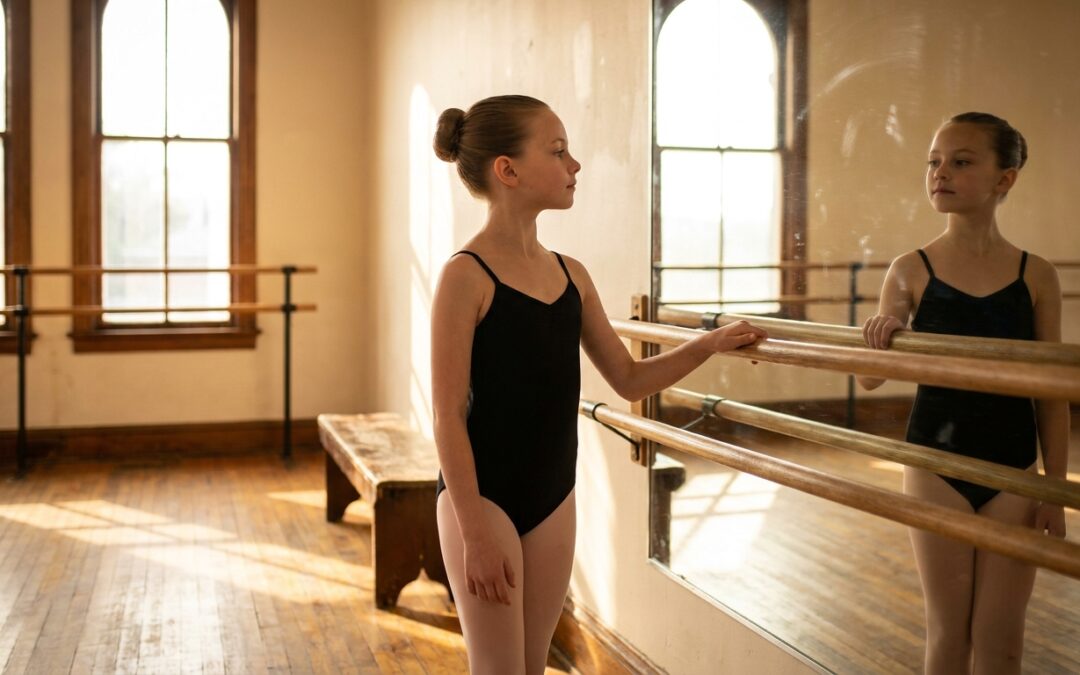
| Ballet segment | Solid-color leotard, pink tights, ballet slippers, bun or neat ponytail | Fancy patterns, midriff-baring tops, hair loose |
| Jazz / hip-hop segment | Fitted dance pants or shorts, jazz shoes or clean dance sneakers | Street shoes, heavy jewelry, distracting accessories |
| Overall presentation | Solid or muted colors, hair pinned neatly, minimal makeup at mini/junior level | Costumes, heavy rhinestones, anything that shifts or falls |
Stick to solid colors so the judges’ eye goes to the movement, not the outfit. Hair should be secure, a bun or tight ponytail eliminates the visual distraction of loose strands and shows the neck and shoulder line clearly. If your child’s tryout confirms specific footwear in the audition packet, follow it exactly.
How to Prepare for a Dance Team Tryout: A 6-Week SGV Parent Checklist
Six weeks out is the right starting point for local SGV tryouts that land in May or June. Work backward from the tryout date and hit each phase in order.
Weeks 6–5: Build the Technical Foundation
- Enroll in or continue consistent technique classes, ballet is the foundation; jazz and hip-hop classes compound on top of it. Do not skip ballet to take more jazz. Directors can see the difference immediately in body placement and core control.
- If the studio offers a pre-tryout clinic or “team prep” workshop, register for it. Clinics let coaches see your child’s effort and attitude before the formal audition, that impression matters.
- Ask the studio for the audition packet or posted requirements so you know the format, age-group schedule, attire rules, and any tryout fee (commonly around $20 for local studio tryouts).
Weeks 4–3: Sharpen Specific Skills
- Identify the two or three technical elements your child needs to clean up, a wobbly single pirouette, sloppy arms in a kick sequence, and give those focused attention in class and short home practice sessions (10–15 minutes, not marathon drilling).
- Practice picking up short combinations from a video or from you calling out movements, then performing them back. This mimics the Day 1 learn-the-combo format and trains choreography retention under mild pressure.
- Assemble the tryout outfit and confirm all shoes fit and are broken in. Nothing derails confidence like a blister from new ballet slippers on tryout morning.
Weeks 2–1: Performance Readiness
- Shift the emphasis from drilling steps to performing them with energy and expression. Record a short home run-through and watch it together, not to criticize, but to celebrate what looks great and note one or two things to sharpen.
- Talk through what the two-day tryout process looks like so it holds no surprises: Day 1 they learn, Day 2 they perform. Callbacks, if offered, are a positive sign, not a warning.
- Prepare the day-of kit: fitted tryout outfit, backup hair ties and bobby pins, band-aids, water bottle, and a light snack (fruit, crackers, or a small sandwich, not sugary drinks or candy that cause an energy crash mid-audition).
Tryout Day
- Arrive early enough to stretch and get comfortable in the space. Rushing in at the last minute spikes nerves and tightens muscles.
- Feed your child a real meal at least 90 minutes before, protein and complex carbs, not just a granola bar.
- Your job as the parent: stay calm, give a confident send-off (“Go show them what you’ve got”), and wait outside. Your visible anxiety transfers directly.
- After the tryout, lead with process praise: “I’m so proud you went up and did your best”, before any conversation about results.
How Should I Handle My Child’s Nerves Before a Dance Audition?
Nerves are normal and, in small doses, actually improve performance by sharpening focus. The goal is not to eliminate them but to give your child a few reliable tools to use when nerves spike.
- Name it: Tell your child directly that butterflies before a tryout are what excitement feels like in the body. Labeling the feeling reduces its power.
- Breathe, then move: Three slow exhales (longer out than in) followed by a short warm-up sequence they know cold resets the nervous system and reminds the body it knows what to do.
- Reframe the stakes: Remind them they are going to show the teachers something they have been working hard on, not going to be judged as a person. The panel is genuinely rooting for every child who walks in.
- Rehearse the room: If possible, take a class at the studio before tryout day so the space feels familiar, not foreign.
What If My Child Doesn’t Make the Team?
Callbacks exist to give directors a second look at specific pairing, look, or level fit, they do not guarantee a spot and are not a consolation prize. Whether a child gets a callback, a spot, or neither, your response as a parent sets the tone for how they process the experience.
- Praise the act of trying, specifically: “You learned that combo in one day. That took real courage and skill.”
- Avoid post-mortems about what went wrong while feelings are still raw. Give it 24 hours before any reflective conversation.
- Frame not making the team as information, not failure: “The directors saw something they wanted to develop more first. Let’s figure out what that means for next season.”
- One of the most consistent patterns in youth performing arts: students who train consistently for another season and re-audition have a much stronger result. The prep process itself builds the dancer.
At Creation Talent Academy, we’ve watched students grow enormously between their first and second audition attempt, sometimes in as little as one focused semester. Our student Mystic Inscho is a vivid example of what consistent, goal-directed training produces; you can read about Mystic’s journey from CTA to the global idol stage for a real look at that progression.
How Do CTA’s Programs Support Dance Audition Readiness?
Creation Talent Academy serves students across Arcadia and the broader San Gabriel Valley with programs designed to build exactly the skills competition-team judges evaluate: ballet foundation, jazz and hip-hop cross-training, performance coaching, and audition preparation. Our partnership with KOD Arcadia brings professional-level dance instruction to the SGV, with age-banded classes from young minis through teen-level performers. If your child is targeting a spring tryout, fall enrollment gives you the full academic-year runway to build technique, add a summer intensive, and arrive at tryouts genuinely ready.
Whether your child is stepping onto a studio floor for the first time or returning to re-audition after a near-miss, the path to a competitive team spot runs through consistent class work, not a last-minute sprint. Start where your child is, build methodically, and the tryout becomes a milestone rather than a gamble.
Common Mistakes to Avoid
- Skipping ballet for “more fun” styles too early. Ballet builds the alignment, core strength, and body awareness that make jazz, hip-hop, and lyrical look clean. Judges see the absence of it immediately.
- Wearing a costume or performance outfit to the tryout. It reads as not understanding the process and can actually distract from your child’s movement.
- Only practicing at home the week before. Technique built under instruction with real-time correction is different from self-directed home review. Both matter, but they are not interchangeable.
- Overscheduling the night before. Sleep and a proper meal do more for performance quality than a final-night practice session that runs late.
- Treating the tryout result as a verdict on your child. Directors place students based on team balance, age-band needs, and seasonal timing, factors that have nothing to do with your child’s worth or potential.
- Missing the pre-tryout clinic. When a studio offers a prep workshop or open rehearsal before the formal audition, attend it. It gives directors a chance to see your child’s attitude and coachability, which are real selection factors.
- Ignoring the attire guidelines in the audition packet. If the packet says ballet slippers for the barre portion and jazz shoes for the combo, bring both. Showing up without the right footwear signals lack of preparation to a panel that notices details.
Frequently Asked Questions
When do youth dance team tryouts happen in Arcadia and the San Gabriel Valley?
Most SGV studio competition-team tryouts fall between late April and June, building rosters for a fall competition season that typically begins in September. A few studios run additional tryouts in late summer for mid-year openings. Check the specific studio’s website or social accounts in February or March to get the confirmed date, and plan your 6-week prep window backward from there.
What is the typical format of a kids’ studio competition team tryout?
The most common local format is two days: Day 1, dancers learn the tryout combination from instructors. Day 2, they review and perform it in front of a judges’ panel. Age-banded sessions separate mini, junior, and teen/elite divisions. Elite and performance tiers often include a callback round, which is an additional look at candidates the directors want to see again, not a guaranteed placement. Some studios charge a small tryout fee, commonly around $20, to cover administrative costs.
How long should my child train before auditioning for a competition team?
Most directors recommend at least one full year of consistent technique training, including a ballet base, before a child’s first competition-team tryout. For younger children (ages 5–8), judges weight focus and choreography retention heavily; for teens, clean turns, strong leaps, and emotional execution become deciding factors. A student who auditions younger and doesn’t make it has more runway to develop than one who waits until 13 or 14 and tries to catch up with students who have been training for years.
What should my child bring on audition day?
Bring the required shoes for each segment of the tryout (usually ballet slippers plus jazz shoes), a secure water bottle, a light snack for between rounds, spare hair ties and bobby pins, band-aids, and a small bag to hold everything. Have the tryout outfit on under a warm-up layer so your child can strip down quickly without a wardrobe scramble. Arrive at least 20 minutes early to stretch and settle in.
Do I need to find a studio specifically in Arcadia, or can my child train anywhere in the SGV?
Your child can train at any quality studio in the San Gabriel Valley and still audition for teams across the area. What matters far more than zip code is the consistency of instruction and the range of styles offered. Look for a studio that teaches ballet as a foundation, layers in jazz or hip-hop, and offers some form of audition or performance coaching. Creation Talent Academy serves students from across the SGV, including Arcadia, Pasadena, Monrovia, and the surrounding communities.