
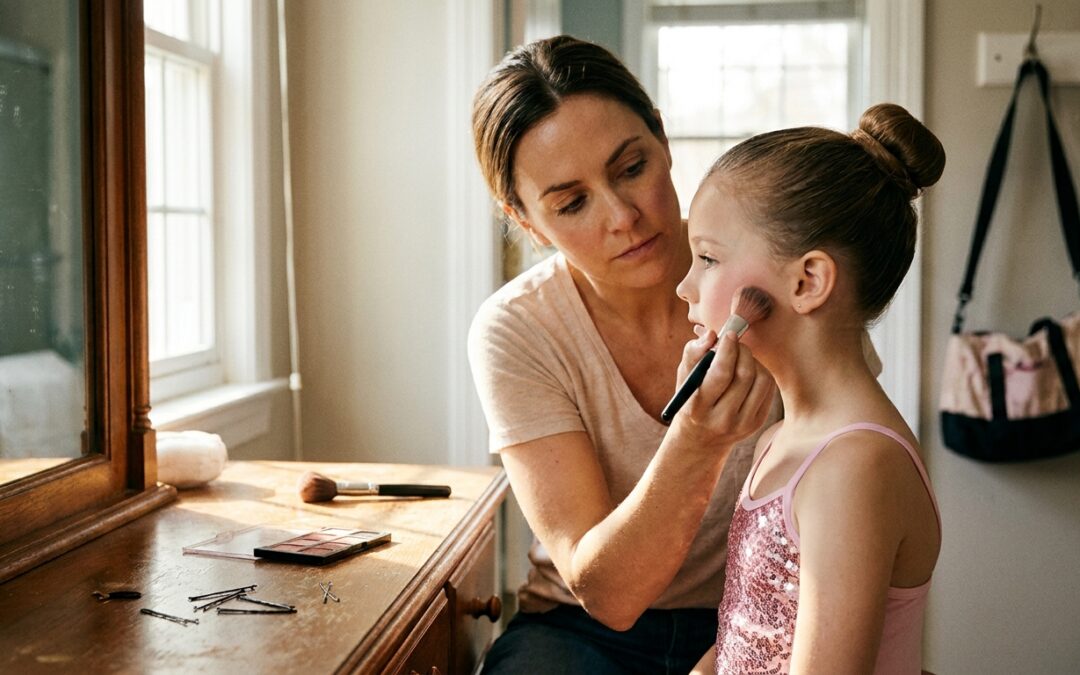
Why Does My Child Need Stage Makeup at All?
Stage lights are extremely bright, and they wash out young faces from even a short distance. Without makeup, your child’s features, their smile, their eyes, their expressions, simply disappear for the audience. The goal of dance recital hair and makeup is not to make your child look older; it is to make their natural features visible under those harsh lights. Off-stage, a properly done recital look should read as “a little more color than usual,” not theatrical or heavy.
At Creation Talent Academy in Arcadia, recital performances follow the same principle seen across San Gabriel Valley studios: features visible from every seat in the house, hair secured so it stays put through every spin, and an overall look that complements the costume without overwhelming a young face. Always confirm your studio’s specific guidelines first, many send a detailed sheet or video tutorial before recital week.
How Do You Do a Recital Bun Step by Step?
The classic slicked-back bun is the standard recital hairstyle across virtually every dance style. Follow these steps and you will get a clean, stage-ready result every time.
- Start with damp, freshly washed hair. Wet hair is easier to smooth and holds product better. Use a spray bottle if hair has dried since washing.
- Apply gel or mousse root-to-tip. Work it through with a fine-tooth comb to eliminate bumps. Do not skimp here, this is what keeps flyaways down under hot stage lights.
- Pull into a high, tight ponytail. Position it at the crown of the head. Use a rattail comb to slick the sides perfectly flat before securing with a hair elastic. No bumps, no parts showing.
- Twist the ponytail into a tight coil. Wrap it around the base of the elastic to form the bun. Hold it firmly in place.
- Pin the bun with bobby pins. Insert pins around the perimeter and across the center in a cross pattern. Crisscrossing pins holds much better than parallel ones.
- Cover with a hair net matching your child’s hair color. Stretch the net over the entire bun and tuck the edges under. Add two or three more bobby pins through the net to lock it down.
- Finish with heavy-hold hairspray. Spray the entire head, smooth any escaping wisps with your fingers, and spray again. The bun should feel solid.
Pro tip: Practice this bun two or three times in the weeks before recital day. The first attempt always takes longer. By the third, you will do it in under ten minutes and your child will know what to expect, making the actual day calmer for everyone.
What About Recital Buns for Kids With Short Hair?
Short hair does not mean your child can skip the bun, it means a slightly different technique. With chin-length or shorter hair, divide the hair into two sections first: an upper section that goes into a small ponytail at the crown, and a lower section that gets pinned upward.
- Upper section: Gather as much hair as possible into a small, tight ponytail at the crown. Secure with an elastic. Twist what you have into a mini bun and pin it firmly.
- Lower section: Spritz with water and apply gel. Separate into two even sections, twist each upward toward the bun, and pin flat against the head with bobby pins so they blend into the bun shape.
- Bangs and wisps: Apply gel, comb them flat against the head, and pin them securely underneath the bun or to the side. Hairspray every loose piece.
- Donut bun form: A foam donut bun insert (available at most beauty supply stores) gives short hair something to wrap around, creating a fuller bun shape even with limited length.
Very short pixie-length hair that truly cannot form a bun is the exception. In those cases, ask your studio director about acceptable alternatives, some programs allow a flat, gelled style with a costume hairpiece pinned on top. This is exactly the kind of question to raise at your first CTA parent meeting before recital season begins.
How Much Makeup Should a Child Wear for a Dance Recital?
The answer depends entirely on age. Younger dancers need very little; the amount scales up as children get older and perform on larger stages with stronger lighting.
| Age Range | What to Apply | What to Skip |
|---|---|---|
| Ages 3 to 6 | Cream blush on cheeks, tinted lip balm or soft pink/red lipstick, brows brushed into place | Foundation, eyeshadow, mascara, eyeliner, too much for little faces and causes battles |
| Ages 7 to 12 | Light translucent powder, rosy blush, neutral matte eyeshadow on lid, one coat of brown or black mascara, lipstick | Eyeliner (save for 10+), false lashes, heavy contour, glitter near eyes |
| Ages 13 and up / teens | Sheer foundation or tinted moisturizer, setting powder, shadow with deeper crease color, eyeliner, blush, bold lip, full stage look | Trend-driven looks, heavy contour, craft glitter (not safe near eyes) |
A few application tips that make the process easier on both of you:
- Blush placement: Ask your child to smile big or “make a fish face” to find the cheekbones. Swirl rosy pink blush on the apples of the cheeks, slightly heavier than looks right up close, blush fades first under bright stage light.
- Eyeshadow: Choose a matte neutral a few shades darker than your child’s skin tone for the lid. Have your child look down at your shoes while you sweep it on, this keeps lids smooth and eyes relaxed.
- Mascara trick: Ask your child to roll their eyes up toward the ceiling while you apply. They won’t see the wand coming and are far less likely to flinch.
- Skin tone matters: On deeper skin tones, pale pinks disappear under stage light, reach for berry, warm rose, or brick for blush. On very fair skin, use a lighter hand because the same lights amplify color.
- Test before recital day: Apply a small amount of foundation on the inside of your child’s wrist a week before the recital to check for any allergic reaction. Choose hypoallergenic products whenever possible, especially for children with sensitive skin.
- Apply makeup close to showtime. Young dancers are not used to wearing makeup and may rub their faces. Waiting until closer to performance time reduces the risk of smudging.
- Put an old shirt over the costume during makeup application to protect the outfit from any product spills.
- Wiggly kids: Break the process into stages, do the face, let them move around for a minute, then do the eyes. Do not try to power through a squirming four-year-old in one sitting.
Do Boys Need Makeup for a Dance Recital?
Yes, and this is one of the most under-addressed questions SGV dance parents ask. Stage lights wash out boys’ faces just as effectively as girls’, and most studios expect all performers to wear at least minimal stage makeup. The key is keeping it natural and masculine in tone.
| Product | What to Do for Boys |
|---|---|
| Foundation | Light application matched exactly to skin tone, blended into the neckline. Young dancers do not need heavy coverage. |
| Translucent powder | Set the foundation to prevent shine under hot lights. This is the most important step for boys. |
| Brow pencil | Fill in brows with small strokes in a shade matching hair color. Blonde dancers should go one shade darker. Groomed brows read expression clearly from the audience. |
| Blush | A warm, rosy color applied sparingly to cheeks and cheekbones, just enough to add warmth, not drama. Avoid orange and brown tones. |
| Lip color | A natural-toned lipstick or tinted balm close to the dancer’s own lip color. No reds, hot pinks, or frosty shades. |
| Eyeliner (older boys, 10+) | Thin line of dark brown along the upper lash line only if requested by the studio. Use a gel or liquid applicator, pencils require too much pressure on a fidgeting child. |
Boys who dance at CTA can check out our dedicated post on boys dance classes in Arcadia for more on what to expect from recital season and beyond, the boys’ makeup question comes up at almost every first recital parent meeting.
How Do You Remove Stage Makeup Gently After the Recital?
Removing makeup from a child’s sensitive skin requires as much care as applying it. Do not use adult face wipes that contain alcohol or fragrance, these sting and can cause irritation, especially around the eyes.
- Use a gentle, fragrance-free micellar water or baby oil on a soft cotton pad to dissolve eye makeup first. Hold the pad against closed eyes for ten seconds before wiping, do not rub.
- Remove foundation and blush with a gentle foaming cleanser designed for kids or sensitive skin. Warm water and two gentle rounds of cleanser should get everything off.
- Apply a light fragrance-free moisturizer after cleansing. Makeup, especially setting powder, can be drying when left on for several hours under stage lights.
- Check behind the ears and along the neckline, foundation and powder often get missed there.
What Should Be in a Dance Recital Bag?
Packing the right bag the night before is the single best thing you can do to stay calm on recital day. Use this checklist:
- Costume(s) on a hanger inside a garment bag, clearly labeled with your child’s name
- Dance shoes (labeled), double-check the style for each number if your child performs in more than one
- Extra tights, at minimum one backup pair; runs happen
- Hair kit: fine-tooth comb, rat-tail comb, bobby pins in your child’s hair color, clear or matching hair elastics, hair net(s), gel or mousse, heavy-hold hairspray
- Makeup kit: everything you used at home, plus cotton swabs for touch-ups and a pressed powder for mid-show shine
- Costume accessories: hairpiece, any pins or clasps that go with the outfit
- Straws, so your child can sip water without smudging lipstick
- Water and snacks, backstage waits are long; pack something easy and not messy
- Old button-front shirt or smock for wearing during makeup application
- Makeup remover and gentle cleanser for after the show
- Small sewing kit, a loose button or snapped elastic snap is fixable if you have a needle and thread
- Your studio’s recital info sheet with call time, backstage location, and order of performances
Pack the bag the night before and run through this list twice. Recital-day morning is not the time to hunt for a hair net.
Common Mistakes to Avoid
- Trying the bun for the first time on recital day. Practice at least twice in the weeks before so both you and your child know what to expect.
- Using the wrong blush shade. Pale pink disappears on medium and deep skin tones under stage light. Match the blush depth to your child’s skin tone.
- Applying makeup too early. Young dancers rub their faces. Apply as close to showtime as practical and keep cotton swabs handy for touch-ups.
- Skipping the hair net. Bobby pins alone will not hold a bun through a full performance. The net is not optional.
- Ignoring the studio’s specific guidelines. Every studio has slightly different expectations for lip color, eyeshadow intensity, and acceptable accessories. Read the sheet your studio sends, it overrides general advice.
- Using craft glitter near the eyes. Cosmetic-grade glitter is the only type acceptable near the face. Craft glitter can scratch corneas. When in doubt, leave it out.
- Skipping boys’ makeup. Fathers especially sometimes push back on this. Remind yourself (and your son) that every male professional dancer wears stage makeup, it is part of the performance, not a fashion statement.
- Forgetting backup tights. This is the number-one item parents regret not packing. Bring two pairs.
Frequently Asked Questions
How much makeup should a 4-year-old wear for a dance recital?
Very little. For a 3 to 6-year-old, cream blush on the cheeks, a soft pink or red lipstick (or tinted balm), and brushed brows are all you need. Skip foundation, eyeshadow, mascara, and eyeliner entirely at this age. The process should take under five minutes and avoid anything near the eyes. A little color goes a long way under stage lights at this age.
What do I do if my child has short hair and can’t make a traditional bun?
Divide short hair into an upper and lower section. Pull the upper section into a small ponytail at the crown, twist it into a mini bun, and pin it. Spritz the lower section, twist each half upward, and pin flat against the head toward the bun. A foam donut bun insert adds volume and gives the hair something to wrap around. Finish with heavy-hold hairspray and a hair net. Very short pixie cuts may need a costume hairpiece instead, confirm with your studio director before recital week.
Do boys wear makeup for a dance recital?
Yes, most studios require it. Stage lights wash out boys’ faces the same as girls’. A minimal boys’ recital look includes light foundation matched to skin tone, translucent powder to prevent shine, groomed brows, and a neutral blush on the cheekbones. Lip color should be close to the dancer’s natural lip shade, not red or pink. Older boys (10 and up) may also need a thin line of brown eyeliner if the studio requests it. Keep all tones warm and natural.
Should I use hypoallergenic makeup for my child’s recital?
Yes, especially if your child has sensitive skin or has never worn makeup before. Test any new product on the inside of the wrist at least a week before recital day. If redness or irritation appears within 24 hours, switch products. Choose fragrance-free formulas where possible, and use a gentle micellar water or baby oil, not alcohol-based wipes, for removal after the show.
When should I confirm hair and makeup requirements with my studio?
As soon as recital packets are sent home, usually four to six weeks before show day. Ask specifically about lipstick color, eyeshadow intensity, whether hair accessories are provided or parent-supplied, and any requirements for boys. Many studios also send video tutorials. At Creation Talent Academy, recital guidance is shared with families well ahead of dress rehearsal so there are no surprises on performance day. If you are still deciding whether CTA is the right fit for your child, our post on when to switch your child’s dance studio walks through exactly what to look for in a studio’s family communication and support.
If your child is newer to performing arts and you are also thinking about how much at-home practice is appropriate between recitals and classes, our guide on how often kids should practice performing arts at home offers practical, age-specific recommendations for Arcadia and SGV families.