Are There Inclusive Performing Arts Classes for Kids with Special Needs in San Gabriel Valley?
Yes, and Arcadia is now one of the most accessible options in the SGV. Performing arts classes for kids with special needs in the San Gabriel Valley have historically skewed Westside (Venice, Santa Monica, Culver City), leaving families in Arcadia, Monrovia, Temple City, and Pasadena driving 45-plus minutes for an inclusive program. Creation Talent Academy (CTA), located at 1229 S. Baldwin Ave in Arcadia, offers acting, singing, dance, martial arts, and public speaking for ages 5–18 and is a certified SDP (Self Determination Program) provider, meaning your Regional Center funding can pay for classes directly.
What Is the Difference Between Adaptive, Inclusive, and Specialized-Only Programs?
These three models are not interchangeable. Before you tour a studio, know what you are actually comparing.
| Model | Who is in the class? | Best for |
|---|---|---|
| Specialized-only | All students have IEPs or diagnoses | Kids who need a highly controlled sensory environment |
| Fully inclusive | Neurodivergent and nondisabled students together | Kids who benefit from peer modeling and social integration |
| Adaptive | Mixed; curriculum is modified per student | Kids who need pacing or sensory adjustments but want mainstream exposure |
CTA operates an adaptive-inclusive model: classes blend students of varied abilities, instructors modify pacing and cuing per student, and the environment is structured but flexible. This matters especially for kids on the autism spectrum or with ADHD, who often regulate better in structured group settings than in one-on-one therapy sessions.
How Does SDP or Regional Center Funding Pay for Arts Classes?
This is the step-by-step process most LA-area guides skip entirely.
- Step 1, Confirm eligibility. Your child must already receive services from a California Regional Center (such as Eastern Los Angeles Regional Center / ELARC, which covers Arcadia and most of the SGV). As of July 2021, the Self Determination Program is available to all eligible Regional Center consumers.
- Step 2, Attend an SDP orientation. This is required before enrollment. ELARC offers orientations in English and Spanish; the State Council on Developmental Disabilities (SCDD) also runs statewide virtual sessions. Completion earns you a certificate to submit to your service coordinator.
- Step 3, Create a Person-Centered Plan. Work with an Independent Facilitator (IF) to document your child’s IPP goals. Arts training goals, communication, self-expression, confidence, social skills, map directly onto common IPP objectives. Bring documentation from your child’s school IEP if available.
- Step 4, Build a spending plan. Your IF and a Financial Management Service (FMS) agency help allocate your individual budget across approved services. Performing arts instruction, and in some cases a 1:1 aide, can be line items in this plan.
- Step 5, Select a certified provider and get a purchase order. Because CTA holds SDP vendor certification, you can list CTA directly in your spending plan. Ask CTA staff to confirm the current vendor number and the service codes that apply to your child’s program before finalizing paperwork.
Under a traditional Regional Center (non-SDP) arrangement, arts classes may also be authorized as social-recreational services, confirm with your service coordinator whether a purchase order can be issued without transitioning fully to SDP.
Which SGV and Greater LA Programs Accept Special Needs Students?
The table below compares programs parents in Arcadia and the broader SGV most frequently ask about. Distance is approximate from central Arcadia.
| Program | Location | Disciplines | SDP / RC Funding | Distance from Arcadia |
|---|---|---|---|---|
| Creation Talent Academy | Arcadia, CA | Acting, voice, dance, martial arts, public speaking | Yes, certified SDP vendor | Local |
| Straight UP Abilities | In-person (Pasadena) + virtual | Performance training | Confirm directly | ~10 min |
| The Miracle Project | Westside / virtual | Theater, film, expressive arts (ages 5–30) | Confirm directly | ~45 min |
| Adrian’s Place / CampEd | Various LA | Camps and enrichment | Yes, RC and SDP accepted | Varies |
For SGV families, CTA is the only Arcadia-based option with documented SDP vendor certification and a multi-discipline curriculum under one roof. Families already enrolled with ELARC do not have to navigate a new regional center catchment area.
What Questions Should You Ask Any Studio Before Enrolling?
Use this checklist at any tour or intake call:
- Are you a certified SDP vendor or an authorized Regional Center vendor? Ask for the vendor number so your service coordinator can verify it.
- What is your 1:1 aide policy? Can a funded aide accompany my child, and does the studio have trained staff who can fill that role?
- What is the student-to-instructor ratio? Smaller ratios (6:1 or better) matter significantly for sensory regulation and attention.
- How do you handle sensory needs? Ask specifically about lighting, sound levels, and break protocols.
- Is there a low-pressure entry point? A trial class or observation session before full enrollment reduces anxiety for both child and parent.
- Do students participate in a showcase or recital? End-of-term performances give kids a concrete goal without requiring solo spotlights, look for ensemble formats.
- Does instruction emphasize creativity over rigid direction-following? Child development experts consistently point to creativity-first environments as better fits for neurodivergent learners.
What Does a First Inclusive Class at CTA Actually Look Like?
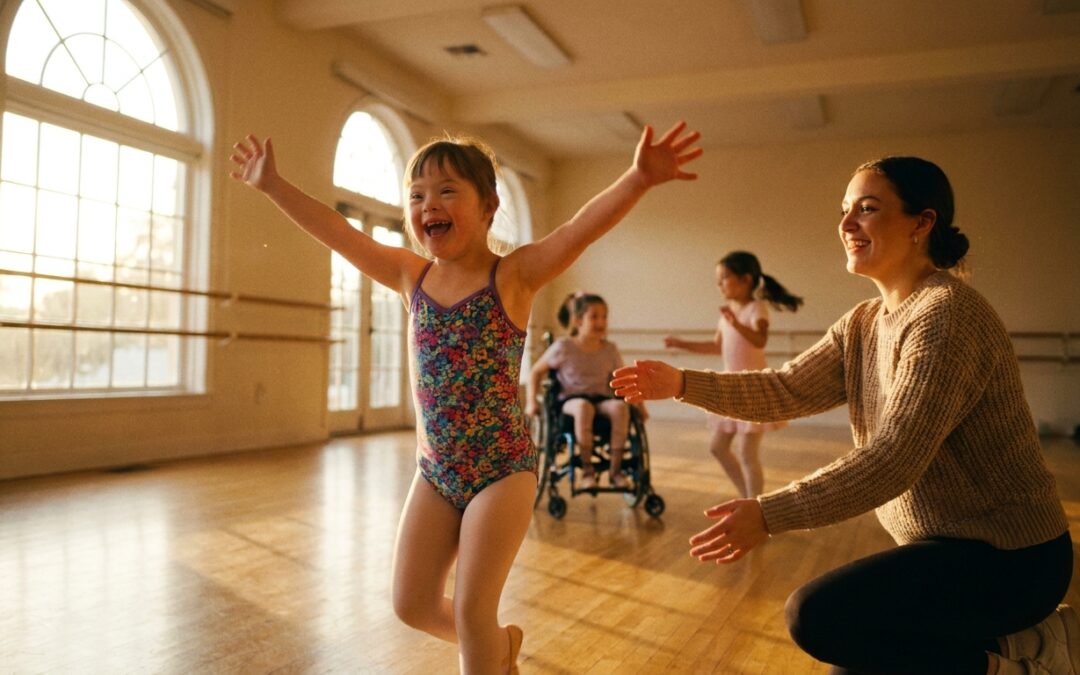
For a child attending for the first time, the structure matters as much as the curriculum. At CTA, classes open with a group warm-up that provides predictable routine, a key regulation tool for kids with autism or sensory processing differences. Instruction is delivered in short segments across disciplines, so a child who needs movement breaks gets them naturally rather than as an exception. The multi-discipline format (acting technique, vocal exercises, movement or martial arts) means a child who struggles with one modality can find a strength in another during the same session.
End-of-term showcases are ensemble-based: every student is on stage together, which distributes the spotlight and lowers individual performance anxiety. Parents are encouraged to observe, giving families a clear view of how their child is supported week over week.
To see what CTA’s performance training looks like at the highest level, read about Mystic Inscho’s journey from CTA to the global idol stage, a reminder that strong foundational training opens real doors for students who commit to the process.
Common Mistakes to Avoid
- Assuming all LA-area “inclusive” programs are SGV-accessible. Most highly rated programs are 40–50 minutes from Arcadia without traffic. Proximity affects attendance consistency, which directly affects progress.
- Not asking for the vendor number upfront. “We work with Regional Center families” is not the same as being a certified vendor. Confirm the number before your service coordinator writes a purchase order.
- Enrolling in a class that is too sensory-demanding from day one. Start with the studio’s smallest or introductory class and escalate once your child has regulated to the environment.
- Skipping the SDP orientation because it feels bureaucratic. The orientation certificate is required before any SDP spending plan is approved, skipping it delays access by weeks or months.
- Choosing a specialized-only program when an inclusive model would serve the child better. Peer modeling and integrated social interaction are documented benefits for many neurodivergent kids; don’t default to segregated settings without considering the alternatives.
- Overlooking multi-discipline programs. A child who shuts down in pure dance may thrive when movement is paired with acting or voice. Single-discipline studios limit the options when one modality isn’t working on a given day.
Frequently Asked Questions
Can Regional Center funding pay for performing arts classes in Arcadia?
Yes. Under the Self Determination Program, your individual budget can cover performing arts instruction at a certified SDP vendor. Under the traditional Regional Center system, arts classes may be authorized as social-recreational services. Contact your ELARC service coordinator to confirm which pathway applies to your child’s IPP goals and current authorization status.
Does my child need a specific diagnosis to enroll in inclusive classes at CTA?
No. CTA’s inclusive programs welcome students of all backgrounds and ability levels. SDP or Regional Center funding does require that your child is an active Regional Center consumer, but enrollment in CTA classes is open regardless of diagnosis. Contact CTA directly to discuss your child’s specific needs and the best program fit.
What performing arts disciplines does CTA offer for kids with special needs?
CTA offers acting, singing, dance, martial arts, and public speaking for students ages 5–18. All of these disciplines are available to students with special needs. The multi-discipline format is particularly useful for neurodivergent children who regulate better when they can move between modalities in a single session.
How long does it take to get SDP funding approved for a performing arts class?
Timeline varies by Regional Center and workload. The process typically involves: attending an orientation (a few weeks to schedule), completing a Person-Centered Plan with an Independent Facilitator (several weeks), and having your spending plan approved. Plan for two to four months from first inquiry to funded enrollment, and ask your service coordinator about any waitlists for Independent Facilitators in the ELARC area.
Is there a program in Arcadia or the SGV that offers both dance and acting for kids with autism?
CTA in Arcadia is currently the only SGV-based studio with both multi-discipline performing arts programming and certified SDP vendor status. Students on the autism spectrum benefit from the predictable class structure, ensemble-based showcases, and the option to move between disciplines when one is over-stimulating on a given day.