
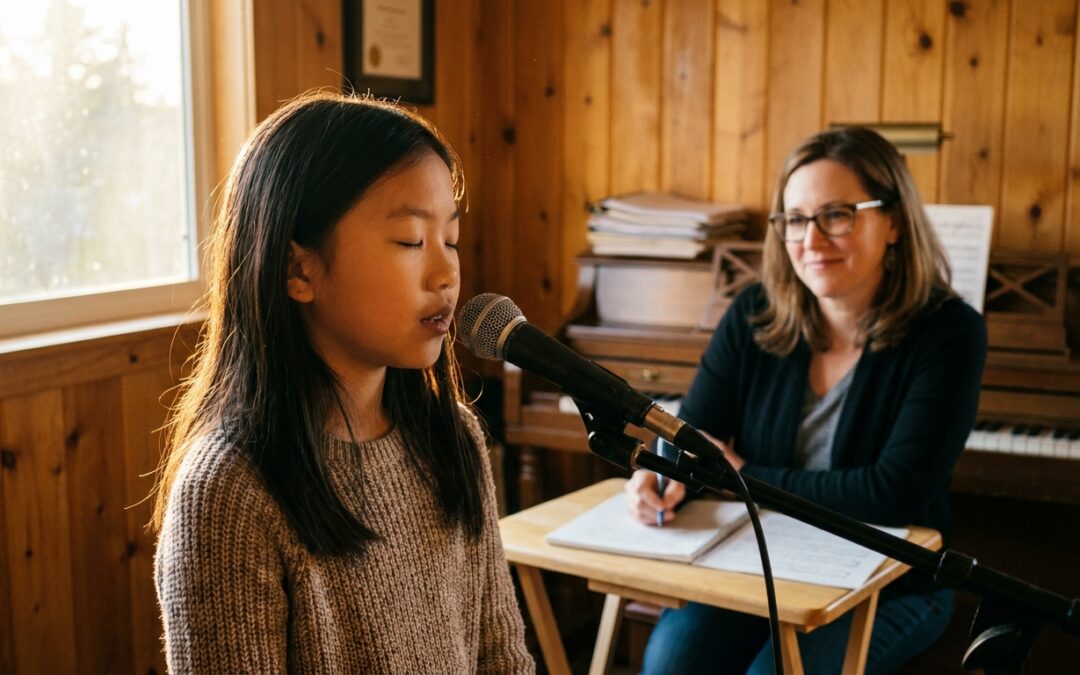
What Is K-Pop Vocal Training for Kids, and How Is It Different from Regular Singing Lessons?
K-pop vocal training for kids is structured singing instruction that builds the core technique required for idol-track performance: breath support, pitch control, rhythmic delivery, and expressive tone. It differs from a standard singing lesson in two key ways. First, the repertoire is rooted in K-pop idioms, meaning students learn to carry rhythm and energy through a song, not just hit correct pitches. Second, the goal is audition-readiness, so coaches track how a student performs under pressure and on material they may not have prepared.
Generic singing lessons focus on tone production in isolation. Idol-track vocal training ties those same fundamentals, breath support, range awareness, ear training, and diction, to real performance scenarios. For families in Arcadia, Temple City, Monrovia, or anywhere else in the San Gabriel Valley, that distinction matters when choosing where to enroll.
Is My Child Ready? Kids vs. Teens in Idol-Track Vocal Work
Age shapes what idol-track vocal training can and should look like. The table below gives parents a practical starting framework.
| Age Group | What They’re Ready For | What to Hold Off On |
|---|---|---|
| Ages 6-8 | Breath basics, matching pitch, simple K-pop melodies in a comfortable key | Sustained belting, full audition-track practice, multi-part harmony |
| Ages 9-11 | Range exploration, ear training, light K-pop repertoire, intro to rhythm drills | Pushing high-belt lines; competitive audition simulation |
| Ages 12-14 | Full idol-track prep: song selection, key adjustments, expression, light audition simulation | Adult-level belting keys; heavy performance schedules without rest days |
| Ages 15+ | Audition-ready sets, agency-style evaluation, multi-song preparation, performance video | Skipping fundamentals to rush an audition |
Voice instruction for children has a long tradition when taught safely and age-appropriately, with breath control forming the foundation of healthy singing at every level. A good coach adjusts expectations to the individual voice, not to what sounds impressive on a highlight reel.
If you are still weighing whether your child is prepared for a performing arts commitment, the guide Singing Lessons for Kids in Arcadia: A San Gabriel Valley Parent’s Guide walks through readiness indicators in detail.
Is Belting Safe for Kids in K-Pop Vocal Training?
Belting an idol’s high notes before a child has the technique to support them strains the vocal folds and can cause lasting damage. The correct approach is to lower the song’s key to match the singer’s current range. This is not a shortcut or an admission of weak skill; it is the standard technique-building strategy used by professional coaches worldwide.
Parents should be concerned if a coach encourages a young student to “just push through” a high passage. Signs of a vocal-health-conscious studio include warm-up routines before every session, regular range checks, rules against singing through illness or vocal fatigue, and willingness to transpose any song down to a safe key. At Creation Talent Academy in Arcadia, vocal instruction is structured around these principles from the first lesson.
What Song Should My Child Sing at a K-Pop Idol Audition?
Song selection is one of the most common mistakes young auditioners make. The guidance from working idol trainers is consistent: sing a K-pop idol song, not a ballad, even if your instinct is to show off vocal power. As trainer Kim Se Yeon, who has coached idol aspirants for over a decade, and Lee Yoonji, principal of Making Academy and a former idol herself, have advised publicly: “sing idol songs well rather than only singing ballads well” because idol songs are rhythmical and let you show your sense of rhythm alongside your voice.
For kids and teens in the SGV, here is a practical song-selection framework:
| Situation | Recommended Approach | Example Song Type |
|---|---|---|
| First audition, ages 10-13 | Mid-tempo K-pop song with a clear melodic hook; transpose down to your comfortable range | Upbeat group track (BTS, TWICE, aespa) in a lower key |
| Strong vocalist wanting to impress | Choose a song with a notable but reachable high note; nail it cleanly rather than straining for something higher | Power ballad-pop hybrid at your actual ceiling |
| Rhythmically confident singer | Choose a song with a prominent groove; let the rhythm carry your energy | Uptempo dance-pop track |
| Asked to sing an unfamiliar song on the spot | Say “I’ll try” and commit; flexibility signals coachability, which auditors value | Any song provided by the panel |
The last point matters more than many parents realize. Trainers note that auditioners who freeze when asked to perform an unfamiliar song signal a lack of adaptability. Children who respond with willingness to try, even imperfectly, demonstrate the mindset agencies look for in trainees.
How Does Idol-Track Vocal Prep Differ from a Self-Study Routine?
Online tutorials and AI-feedback apps offer a general sequence for self-study: find your range, build breath and phonation, choose matching songs, and self-correct with recordings. That framework is useful as a starting point, but it has real limits for kids pursuing a serious idol track.
A coach catches problems a recording cannot: shallow breath placement, a jaw position that limits resonance, a habit of scooping into pitches. More importantly, a coach can create audition simulations, giving your child experience performing under mild pressure with an unfamiliar prompt, which is exactly what a real agency audition requires. Self-study produces cover videos; coached training produces audition-ready singers.
For families exploring the full idol-track picture, including how dance and acting training intersect with vocal work, the post K-Pop Idol Training for Kids in the San Gabriel Valley: A Parent’s Complete Guide covers the multi-disciplinary path in depth.
How Do I Find a K-Pop Vocal Coach in the San Gabriel Valley?
Offshore coaching services and AI apps have grown in number, but they cannot replicate in-person feedback on a child’s voice. When evaluating a local SGV studio, ask these specific questions:
- Does the coach have experience with youth voices specifically? Adult vocal technique does not translate directly to children and adolescents.
- How does the studio handle vocal health? Look for mandatory warm-ups, key transposition as a standard practice, and no-sing policies when a student is sick.
- Is idol-track repertoire part of the curriculum, or is K-pop treated as a novelty? A studio that takes idol prep seriously will work through K-pop songs systematically, not just on request.
- Can vocal training connect to dance and performance coaching? Idol auditions assess the full package. A studio that ties vocal work to movement and stage presence gives students a real edge.
- Is a trial class available? One session should tell you whether the coach adjusts to the individual child or runs everyone through the same material regardless of age or range.
Creation Talent Academy, based in Arcadia and serving families across the San Gabriel Valley from Temple City to Pasadena, structures its vocal program around exactly these principles. Students can train in singing alongside K-pop dance and acting, which mirrors how real idol-track agencies evaluate talent.
Common Mistakes to Avoid
- Choosing an audition song in the original key regardless of range. Singing a song too high strains the voice and produces a weaker result than a transposed, confident performance.
- Relying only on self-study or online tutorials. Without a coach, technical flaws get reinforced, not corrected.
- Selecting a ballad for an idol audition. Idol trainers consistently advise against this; ballads do not show the rhythmic energy agencies prioritize.
- Skipping fundamentals to rush into performance repertoire. Breath support, pitch control, and ear training take weeks to build; shortcuts show up immediately under pressure.
- Ignoring vocal rest. Young singers need recovery time. Daily heavy practice without rest days increases injury risk.
- Freezing when asked to sing an unfamiliar song. Train your child to respond with willingness to try, not a refusal to attempt material they have not rehearsed.
Frequently Asked Questions
What age can kids start kpop vocal training?
Most vocal coaches work with children from around age 6 or 7 for foundational breath and pitch work. Idol-track training with audition simulation is typically introduced between ages 11 and 13, when a student has enough vocal development and attention span to benefit from performance-level coaching.
Do K-pop idol auditions require singing in Korean?
No. Singing in Korean is not required, and many US-based auditions accept English-language K-pop songs or even Western pop. What matters is vocal skill, rhythmic awareness, and stage presence. That said, learning phonetics for a Korean-language song can demonstrate commitment and cultural awareness to a panel.
How long does it take to prepare for a K-pop idol audition?
A realistic preparation timeline for a beginner is six to twelve months of consistent weekly coaching to build foundational technique plus audition-specific repertoire. Students with prior vocal training may be audition-ready in three to six months, depending on the agency’s standards and the student’s age range.
Should my child take dance alongside vocal training for idol prep?
Yes. Idol agencies evaluate the full package: voice, movement, expression, and adaptability. Starting K-Pop dance classes for kids in the San Gabriel Valley alongside vocal coaching lets your child develop both skills simultaneously, which is how trainees at major agencies actually train.
How do I know if a vocal coach is right for idol-track training specifically?
Ask the coach directly whether they have prepared students for idol-style auditions, whether they transpose songs for student range as a standard practice, and whether the curriculum includes K-pop repertoire and rhythm work, not just classical or musical-theater technique. A trial lesson is the fastest way to assess fit.