What Age Can Kids Start Singing Lessons in Arcadia?
Most children in the San Gabriel Valley are ready for structured singing lessons for kids in Arcadia somewhere between ages 7 and 10, but readiness is driven more by maturity than by a birthday. Students who start singing lessons should be socially mature enough to focus in the lesson room and follow the coaching of their vocal teacher. If your child can hold a conversation with an adult, follow a two-step direction, and genuinely wants to sing, age is secondary.
That said, you will find real disagreement among teachers about the right start age, and it is worth knowing both sides. Many voice teachers and pedagogues believe that voice lessons should begin no earlier than age 12 for female voices and age 15 for male voices. The reasoning is anatomical: during puberty, between ages 10 and 14 for females and 12 and 16 for males, the voice changes because the larynx grows and descends while the vocal cords thicken and grow, and before this physical change occurs, it can be difficult to begin intense voice training. A more moderate view, and the one most local SGV families will encounter, is a tiered approach based on age and goal.
A Practical Age-Readiness Ladder for SGV Parents
| Age Range | Best Vocal Activity | What to Look For |
|---|---|---|
| Ages 4–6 | Singing through play, movement, solfege, early music exposure | Enjoyment of music, willingness to repeat sounds |
| Ages 6–8 | Group singing, vocal foundations class, choir | Can follow simple melodic directions; sustains focus ~15–20 min |
| Ages 9–12 | Structured private or small-group voice lessons, skill building | Self-motivated, can practice between sessions, interested in performance |
| Ages 13+ | Focused private lessons, audition prep, idol/musical-theater track | Clear performance goals; emotionally ready to receive coaching |
Younger children can benefit from music classes that introduce rhythm, listening, and vocal play, and these experiences often prepare them for more structured lessons later. For Arcadia and Pasadena-area families thinking about a performing-arts path, that early foundation matters: a child who has played with solfege, clapped rhythms, and sung in a group will absorb private voice coaching faster at age 9 than a peer who starts cold.
Why Does a Child’s Developing Voice Require a Different Approach?
A child’s voice is not a small adult voice. Before puberty, the larynx and vocal cords are small and thin, which is why a child’s voice is higher than an adult’s. Between ages 6 and 12, both the respiratory and phonatory systems grow rapidly, so voice training at this stage should focus on playfulness, breath exploration, and healthy coordination, not tone shaping or range extension.
The voice change during puberty adds another layer of complexity for teen singers in the SGV. As a child goes through puberty, the larynx gets bigger and the vocal cords lengthen and thicken, causing the voice to get deeper, and as the body adjusts, the voice may crack or break. For most male singers, the larynx grows by 60–70%, lowering pitch by about an octave, while for female singers the change is subtler, around a 20% increase, with timbral shifts and slight range adjustments.
The practical rule for any teen vocal student: a skilled coach knows that in the early years the focus should be on flexibility rather than power; lessons should encourage open, relaxed, and tension-free singing, and strengthening can come later once the vocal structure has matured enough to handle it. A coach who pushes a 13-year-old to belt through a voice change is not the right fit, regardless of how impressive the studio looks on Instagram.
Private Voice Lessons vs. Group Vocal Class: Which Is Right for a Beginner?
This is one of the most common questions SGV parents ask, and the honest answer depends on your child’s age and goal rather than on what happens to be available at a particular school.
| Format | Best For | Typical Age Fit | Trade-offs |
|---|---|---|---|
| Group vocal / choir | Ear training, confidence building, musical play, overcoming stage fright | Ages 5–10 especially | Less individual feedback; great social motivation |
| Private voice lessons | Technique development, audition prep, idol/musical-theater track | Ages 9+ (maturity-dependent) | Requires self-motivation; faster skill gains |
| Private + ensemble combo | Complete vocal performer development | Ages 11+ | Higher time/cost commitment; strongest long-term results |
Whether a child is ready for vocal technique is more contingent on emotional maturity than vocal maturity. A shy 9-year-old who freezes in a group setting may thrive in a one-on-one lesson where a trusted coach can build trust slowly. A socially driven 8-year-old who loves singing along to K-pop with friends may benefit more from a group vocal class first, then transition to private lessons once she has stage-presence confidence. Neither path is wrong: the goal is consistent engagement, not the fastest possible technique.
Performing-Arts Idol Track vs. a Generic Music School: How Are They Different?
This distinction matters more than most Arcadia and San Gabriel Valley parents realize when they start searching for voice lessons. The majority of local music schools, including several on Huntington Drive, are piano-and-guitar-first studios that list voice lessons as one item among many instruments. They are not wrong choices for a child who wants to casually explore singing, but they are a fundamentally different product from a performing-arts vocal program.
Here is what separates the two:
- Curriculum goal: A music-school voice program typically focuses on pitch accuracy, basic breath support, and one or two songs per semester. A performing-arts idol track connects vocal technique to performance: mic technique, stage movement, expression, and genre-specific stylistic choices relevant to musical theater, K-pop, pop, or R&B.
- Integration with other skills: At a performing-arts academy, vocal training sits alongside acting, dance, and ensemble rehearsal. A singer who also trains in youth musical theater learns how to deliver a lyric dramatically, not just sing it in tune.
- Performance pathways: Idol-track programs build toward showcases, competition stages, and real auditions. A piano school recital and an idol showcase are genuinely different preparation experiences.
- Coach profile: Look for a coach whose background is in contemporary vocal performance, not exclusively classical or piano pedagogy. The techniques used for a pop ballad or a K-pop showcase differ meaningfully from those used for a classical art song.
- K-pop and idol-specific training: The SGV has one of the largest K-pop fan and training communities outside Korea. If your child is interested in idol performance specifically, see our guide to K-pop idol training for kids in the San Gabriel Valley for how vocal training fits within that full-performer path.
If your child’s goal is to perform in school musicals, compete in vocal showcases, audition for professional productions, or build a complete idol skill set, a performing-arts vocal program in Arcadia will serve them better than a general music school’s voice elective.
What Should a Vocal Lesson Actually Look Like for Kids?
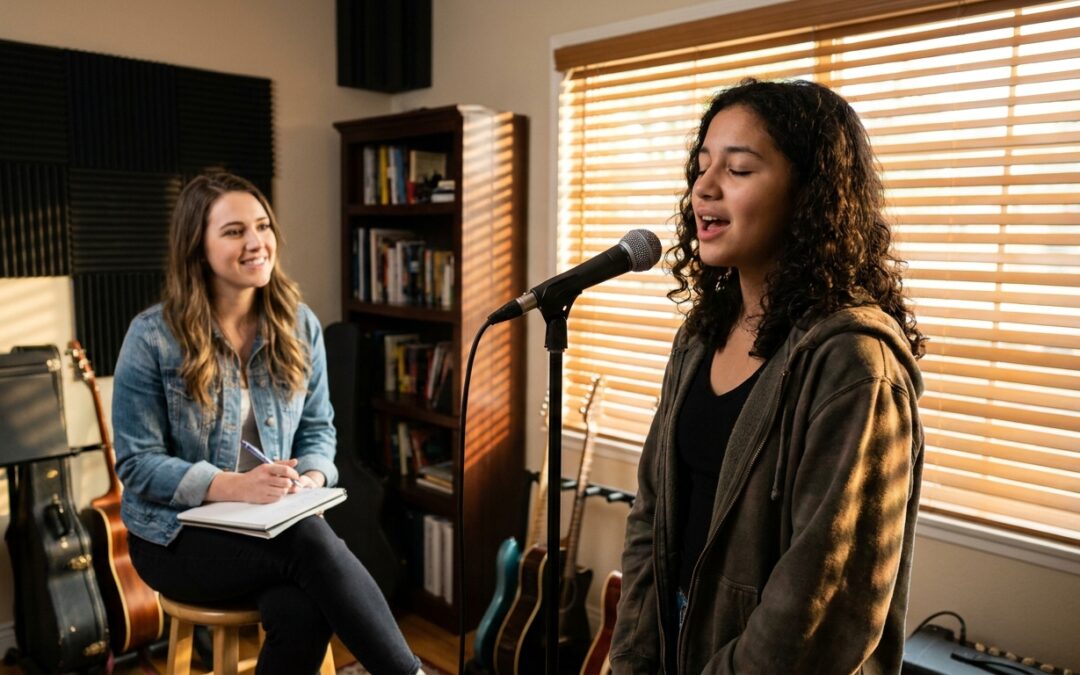
Parents sitting in on a first lesson for a 9-year-old should expect something that looks more playful than rigid. A child will begin to learn fundamental vocal techniques including effective breathing for singing, articulation with fun tongue twisters, and a general understanding of how the voice works, and will also begin learning to read music using solfege. Scales, lip trills, humming exercises, and short melodic phrases build coordination before repertoire is introduced.
For a teen student preparing for an audition or a school musical, the session structure shifts toward genre technique, performance delivery, and song interpretation. Helping kids learn to shift registers early can be especially beneficial for their vocal health, because it keeps them from trying to scream higher and higher when singing along with a high song. A good coach will address register transitions explicitly, especially with students going through puberty.
One critical scheduling note: in addition to voice lessons, students need to set aside time to practice daily, or at least throughout the week, in order to learn to sing. A few emergency lessons before a recital or audition will not replicate the gains from twelve weeks of consistent weekly work. Consistent regular training is the only path to real vocal development, and that is as true for a 10-year-old in Arcadia as it is for a professional adult.
How to Choose a Singing Studio in Arcadia and the San Gabriel Valley
The Yelp and Lessons.com directories that dominate local search results list studios but give parents zero decision framework. Here is a working checklist:
- Ask about the coach’s genre background. A classical-only background is not automatically right for a child who wants to sing musical theater or idol pop. Ask for specific genre experience.
- Confirm the approach to vocal health for young singers. A responsible coach will discuss register flexibility, avoid over-belting, and adapt exercises when a teen’s voice is changing.
- Look for performance integration. Showcases, ensemble work, and real performance experience build more complete singers than technique-only instruction.
- Check whether vocal training connects to other disciplines. If your child is also interested in acting or dance, a school where all three are available under one roof offers significant long-term advantages. Our broader guide to choosing a performing arts studio for kids in the San Gabriel Valley covers the full framework.
- Ask what a “beginner” first lesson looks like. The answer should include ear training, breath basics, and playful engagement, not immediately running scales at full volume.
- Trial lesson availability. Any reputable Arcadia studio should offer the ability to observe or trial a lesson before committing to a semester.
Common Mistakes to Avoid
- Starting too advanced too soon. Enrolling a 7-year-old in adult-style private technique lessons because she “loves to sing” often leads to boredom or frustration. Group singing or a foundational class is a better first step.
- Pushing power before flexibility. Encouraging a child to sing loudly or forcing high notes before vocal coordination is established risks strain and bad habits that take years to undo.
- Ignoring the voice change in teens. A teen whose voice is changing needs adjusted repertoire and lighter technical demands, not the same material she sang two years ago. Coaches who ignore this risk vocal injury.
- Cramming before auditions or recitals. Booking five lessons in the two weeks before a performance after months of inactivity is far less effective than consistent weekly training throughout the semester.
- Choosing a studio purely by proximity. The closest school on Huntington Drive or in Pasadena is not necessarily the best fit. Curriculum match, coach background, and performance pathway matter more than a 5-minute shorter drive.
- Skipping performance experience. Technique without performance practice produces students who can sing in a lesson room but freeze on stage. Showcases, ensemble singing, and even informal performances should be part of any serious vocal program.
Frequently Asked Questions
What is the best age to start singing lessons for kids in Arcadia?
Most voice coaches and music educators place readiness between ages 7 and 10 for structured private lessons, with group vocal programs appropriate from around age 6. Maturity, attention span, and genuine desire to sing matter more than the exact age. Children under 6 benefit most from musical play, solfege, and choir rather than private technique sessions.
Is it safe for a child’s voice to take lessons before puberty?
Yes, with the right coach. Before puberty, the larynx and vocal cords are small and thin, so age-appropriate lessons focus on breath, coordination, and register flexibility rather than power or range extension. A qualified coach avoids strain and adapts exercises to the child’s physical development at every stage.
What happens to a teen’s singing voice during puberty, and should they keep training?
During puberty, the larynx grows and the vocal cords lengthen and thicken, causing the voice to deepen and sometimes crack unpredictably. Teen singers should absolutely continue training through this period, but with a coach who adjusts repertoire to the new comfortable range and avoids pushing through strain. Consistent, gentle technique work during the voice change builds a stronger adult instrument.
What is the difference between a performing-arts vocal program and a regular music school voice lesson?
A general music school voice lesson focuses on pitch accuracy and breath support as standalone skills. A performing-arts vocal program, like an idol or musical-theater track, integrates technique with stage performance, mic work, expression, genre style, and real showcase or audition preparation. For a child with performance goals, the performing-arts model produces fuller results.
How do I know if my child is ready for private voice lessons vs. a group vocal class?
Group vocal classes are ideal for ages 5–10 who want to build confidence, develop their ear, and enjoy music socially without the pressure of one-on-one coaching. Private lessons suit children who are self-motivated, can sustain 30 minutes of focused attention, and have a specific performance goal such as a school musical audition, idol showcase, or competition. Many students benefit from both at different stages.