
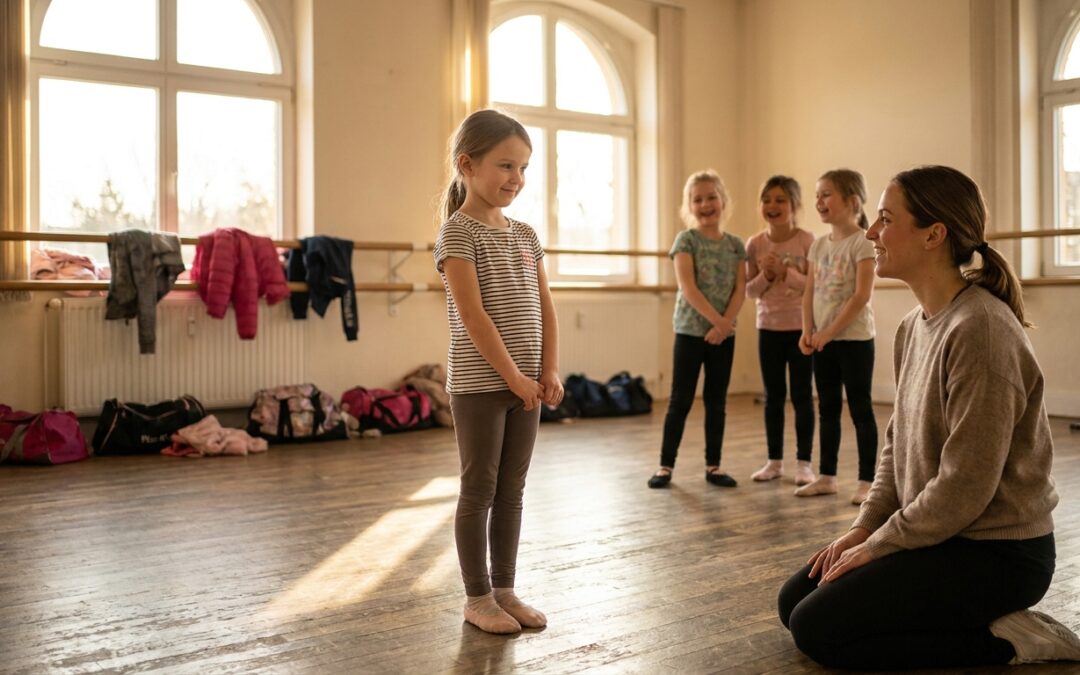
Do Acting Classes for Shy Kids Actually Help?
Yes, acting classes for shy kids are one of the most consistently effective confidence-building tools available, and the research backs it up. The reason is structural: drama gives a child clear rules, defined roles, and a shared creative task, which makes social interaction far less threatening than the unstructured playground does. A well-run class removes your child from established school-yard reputations and gives them a genuine fresh start where nobody has already decided who they are.
That said, how it helps matters. The answer is not simply “put them on a stage.” The format, the class size, and the instructor’s approach determine whether a shy child opens up or shuts down further. This guide gives you the decision framework to choose right the first time, specifically for families in Arcadia, Temple City, Monrovia, Pasadena, and the broader San Gabriel Valley.
Why Do Drama Classes Build Confidence in Quiet Children?
Drama training builds the exact skills shy kids struggle with most, but it practices them through play, not pressure. Here is what a good class is actually developing session by session:
- Active listening. Scene work requires intense focus on a partner, a skill introverted kids often already excel at. It rewards them for something they naturally do well.
- Emotional recognition and expression. Naming and physically embodying emotions through characters gives children a safe vocabulary for feelings they may otherwise bottle up.
- Clear communication. Voice projection, articulation, and body language are taught as technical skills with repeatable exercises, not as vague social demands.
- Collaboration with structure. Group scenes and ensemble exercises spread attention across many kids. No single child is left alone under a spotlight while everyone watches.
- Risk-taking as the norm. In drama, forgetting a line or going big with a character choice is part of the process, not a reason for embarrassment. Mistakes are treated as information, not failure.
One key psychological mechanism: when a child plays a character, any awkward moment belongs to the character, not to them. This “character as protection” layer lets shy kids experiment with bolder voices and bigger expressions than they would ever risk as themselves, and over time, that boldness leaks into their real-life behavior.
Acting vs. Improv vs. Musical Theatre: Which Format Should a Shy Child Start With?
This is the question most national guides skip, but it is the most important decision you will make. Each format builds confidence differently, and the wrong starting point can overwhelm a child before they have time to settle in.
| Format | How it builds confidence | Best for a shy child who… | Watch out if… |
|---|---|---|---|
| Acting (scene study) | Script gives a safety net, your child always knows what comes next. Pairs and small groups, not solo spotlights. | Is thoughtful and observant; loves stories; needs to know the rules before joining in | They freeze under any performance pressure, start with improv games first |
| Improv | No script means nothing to memorize or mess up. Games teach “yes, and” thinking, which redirects perfectionism. | Is a worrier about getting things wrong; needs permission to be silly without judgment | They are highly anxious about unpredictability, a scripted class may feel safer initially |
| Musical Theatre | Music and movement carry emotional expression, reducing reliance on pure spoken confidence. Ensemble numbers spread the spotlight. | Already loves music or dance and wants a combined experience; thrives with structure and rhythm | The multi-skill demand (sing + move + speak simultaneously) feels like too much at once |
The practical recommendation: For most shy kids ages 5-10, a beginner acting class with a heavy improv-games component is the lowest-friction starting point. The script gives security; the games give permission to play. If your child already takes dance or sings at home, musical theatre can be a natural bridge. For older kids (11+) who freeze under performance pressure, a dedicated improv class for kids is worth considering as a standalone confidence primer before adding scene study.
Normal Shyness vs. Anxiety: When Is Acting Class the Right Tool?
Most shy children are simply reserved by temperament, they warm up slowly, prefer one-on-one or small-group settings, and are highly observant before they act. Acting class is an excellent fit for this profile. The concern is when shyness crosses into clinical social anxiety: persistent physical symptoms (stomachaches, crying before every class), avoidance that does not ease after a few sessions, or distress that is worsening rather than gradually lifting.
| Sign | Likely normal shyness | Consider professional support too |
|---|---|---|
| First-day nerves | Clingy at drop-off, watches from the side initially | Full meltdown at every session after 4+ weeks |
| Participation pace | Joins in gradually over 3-6 weeks | Refuses to participate at all after 6+ weeks |
| Physical symptoms | Butterflies before class, gone once inside | Stomachaches, headaches, or crying persisting weekly |
| Post-class mood | Relieved, happy, starts talking about class at home | Consistently withdrawn or distressed afterward |
Acting class is a powerful tool, not a therapy replacement. If your child shows consistent clinical-anxiety signs, pair classes with support from a pediatric therapist who can help them process fears alongside their studio work. For most SGV kids who are simply quiet or slow-to-warm, a patient instructor in a small-group setting is all they need.
What Does Progress Actually Look Like? A Week-by-Week Milestone Guide
National guides say “kids blossom” but rarely tell you what to look for or how long it takes. Here is a realistic, observable timeline for a shy child in a well-run beginner acting class.
- Weeks 1-2: Your child watches more than they participate. They stay near the edge of the group, laugh at others’ exercises, and begin learning classmates’ names. This is productive behavior, not a problem.
- Weeks 3-4: They join group warm-up games without prompting. They make eye contact with the instructor and respond to direct questions with short answers. At home, they may re-enact a game they played in class.
- Weeks 5-6: They volunteer for a short exercise or ask a question in class. They mention classmates by name at home. You may notice them speaking more readily with adults outside class (a teacher, a neighbor, a store clerk).
- Weeks 7-10: They take on a character role in a short scene and commit to it, even in front of the full class. Eye contact, voice volume, and willingness to be “wrong” all noticeably improve.
- Months 3-6: Transfer effects appear consistently: better willingness to try new activities, less anxiety about being called on at school, stronger peer friendships, and higher self-reported confidence. Parents commonly describe this phase as “a different kid.”
Progress is rarely linear. A child who had a great week may go quiet again the next session if the group dynamic shifted or something stressful happened at school. That is normal. Watch the trend over a month, not a single class.
How to Choose a Shy-Kid-Friendly Studio in the San Gabriel Valley
This is the question no national guide answers, and it is the most practical decision SGV parents face. Here is exactly what to evaluate when comparing studios in Arcadia, Temple City, Pasadena, or Monrovia.
- Class size. This is the single biggest variable. A shy child in a class of 20 will hide; a shy child in a class of 4-8 gets seen, supported, and gently challenged. Ask for the actual enrolled headcount, not the maximum capacity.
- Trial class policy. A studio confident in its environment for beginners will offer a free first class with no commitment. This matters enormously for a shy child who needs to observe before they invest emotionally.
- Observe-first option. Can your child sit to the side for part of the first session? Good instructors accommodate this. Forcing participation from minute one is a red flag for shy kids.
- Instructor background. Working-professional instructors who have navigated real auditions and productions understand nervous energy as a tool, not a problem. They also tend to set clearer expectations, which makes the environment more predictable for anxious kids.
- Age-appropriate grouping. A 7-year-old grouped with 13-year-olds will shrink. Confirm that classes are separated by both age and skill level.
- Year-round enrollment. Starting mid-year in an established group is intimidating. Studios with rolling enrollment let your child join at any point without feeling like the permanent outsider.
Creation Talent Academy in Arcadia runs classes of just 4-8 students for ages 5-18, enrolls new students year-round, offers a free first trial class, and places every new student by level rather than just age, so a shy 9-year-old is never dropped into an advanced group. Instructors are working industry professionals who have led youth conservatory programs across Los Angeles. That combination is rare in the 626, and it is exactly what a quiet child needs to begin.
How to Set Up Your Child’s First Day Without Adding Pressure
What parents do before and after the first class matters as much as what happens inside it. These specific steps reduce first-day friction for shy kids.
- Visit the studio in advance. If possible, walk through the space when no class is in session. Familiarity with the room removes one layer of uncertainty on the actual first day.
- Meet the instructor beforehand. A five-minute introduction so your child has one friendly face they recognize when they walk in makes a significant difference.
- Use low-pressure language. “We’re going to try a class and see how you like it” is far better than “you’re going to love this!” which sets a performance expectation. Give them permission to not love it immediately.
- Play simple theatre games at home first. Mirror games, “yes, and” conversations, and character voices at the dinner table lower the novelty factor before the first class.
- Drop off and step back. Hovering at the studio door makes a child watch for your reaction rather than engaging with the class. A clean drop-off with a calm goodbye is almost always better for a shy kid.
- Do not over-praise. “You were SO BRAVE!” after a tentative first class turns next week into a performance where they have to live up to that label. Instead, ask curious questions: “What was one game you played?” or “Who did you stand next to?”
- Start at the right level. Pushing a shy beginner into an intermediate class because they seem “smart enough” is a fast way to trigger withdrawal. Beginners’ classes are where confidence foundations are built.
If your child is nervous specifically about their first session, our related guide on handling first-acting-class nerves walks through the drop-off conversation and the post-class debrief in more detail.
Common Mistakes to Avoid
- Choosing a large class to “push them out of their shell.” High-volume environments cause shy kids to retreat further, not open up. Small classes are not a convenience feature, they are a clinical necessity for this temperament.
- Switching studios too quickly. Three weeks is not enough time to evaluate. Shy kids need 6-8 weeks to establish comfort with a new environment. Pulling them before that teaches them that discomfort is a reason to quit.
- Enrolling in the wrong format for their anxiety profile. Putting a perfectionist child directly into improv with no script can spike anxiety before it reduces it. Match the format to the child’s specific fear pattern (see the table above).
- Skipping the instructor conversation. Never enroll without speaking to the actual teacher first. Ask directly: “How do you handle a child who wants to watch rather than participate for the first few sessions?” The answer tells you everything.
- Treating the first recital as the progress benchmark. The real gains happen in weeks 3-10, in class, before any performance. If you only measure by the showcase, you will miss most of the growth.
- Comparing to siblings or classmates. Even a passing “your sister jumped right in” comment can turn a shy child’s natural progress pace into a source of shame rather than pride.
Frequently Asked Questions
How old should my shy child be before starting acting classes?
Ages 5-6 is a natural starting point for most children, including shy ones. At that age, classes focus on movement, imagination, and simple games rather than memorized scenes, which keeps the pressure low. CTA’s Discovery program is designed specifically for ages 4-6 who are new to performing arts. That said, there is no wrong age to start, shy teens benefit just as meaningfully from a well-structured beginner acting class as younger children do. For teens, see our guide to teen acting classes in Arcadia and the San Gabriel Valley.
Will my child be forced to perform in front of people right away?
In a well-run program, no. Good instructors let shy kids observe from the side in early sessions and invite participation rather than demanding it. At CTA, progress is reviewed each term and students advance at their own pace, no child is pushed into a showcase moment they are not ready for. Ask any studio you are considering about their specific policy for new students who want to watch before joining.
Is improv or acting better for a very anxious child?
It depends on the type of anxiety. If your child’s fear is about making mistakes or being judged, improv is often better because there is no script to get wrong. If their anxiety is about unpredictability and not knowing what to expect, a scripted acting class with clear structure may feel safer. Many families start with a beginner acting class that incorporates improv games and find that combination covers both bases well.
How do I know if the class is actually working?
Watch for transfer effects outside the studio, not just in-class participation. Signs it is working include: your child mentions classmates by name, they volunteer answers at school more readily, they make eye contact with unfamiliar adults, they re-enact exercises at home unprompted, and they push back less on trying new activities in other parts of their life. These changes typically become visible between weeks 6 and 12 of consistent attendance.
Can acting classes help if my child also has diagnosed anxiety?
Yes, as a complement to professional support, not as a replacement for it. Many pediatric therapists actively recommend structured creative activities alongside therapy because the skills practiced in drama (emotional labeling, controlled breathing, regulated risk-taking) reinforce therapeutic goals. If your child has a formal diagnosis, share that with the studio when enrolling so the instructor can communicate accordingly. CTA also serves students with special needs through its certified Self Determination Program services.