
Is My Child Ready for Ballet Classes for Kids in Arcadia?
Readiness signals matter more than a birthday. For children as young as 3 or 4, pre-ballet and creative movement classes introduce rhythm and body awareness without formal technique. Formal ballet instruction, barre work, positional vocabulary, and structured class sequences, typically suits children around age 6 or 7, when attention span and bone development can support it. Before enrolling, look for three things in your child: the ability to follow simple multi-step directions, genuine enjoyment of music and movement, and comfort being apart from you for 45 to 60 minutes.
What Is the Difference Between Pre-Ballet and Formal Ballet?
Pre-ballet (sometimes called creative movement or “dance tots”) is play-structured and imagination-driven. Teachers use props, stories, and songs to develop spatial awareness and coordination. There are no barres, no turned-out feet, and no exams. Most SGV studios offer pre-ballet from ages 3 to 5.
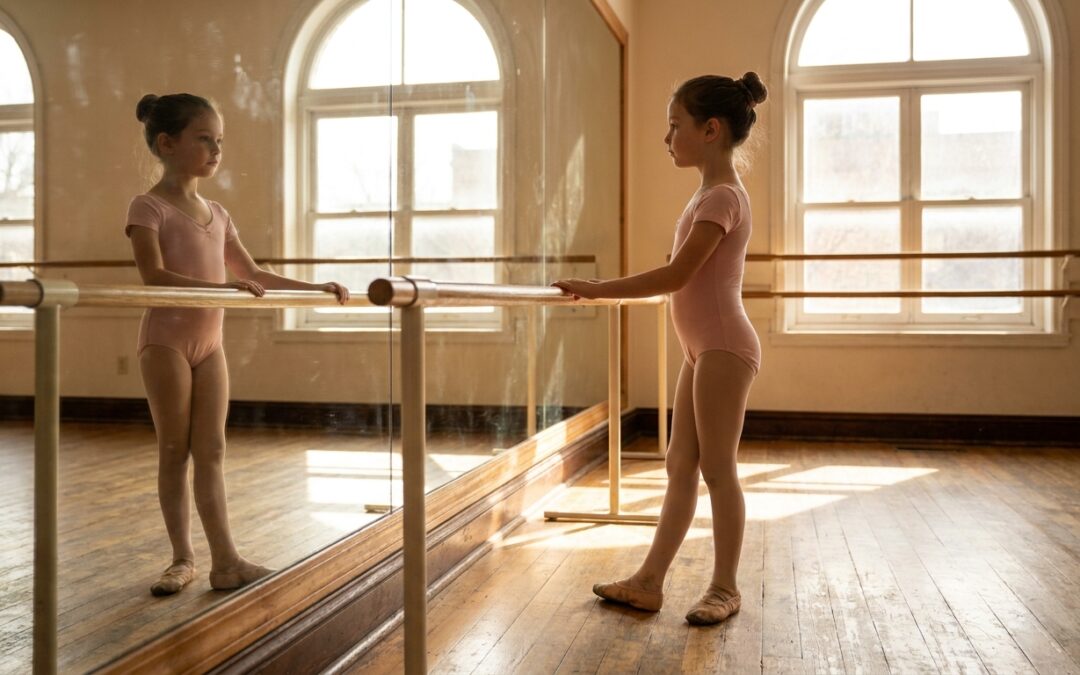
Formal ballet begins around age 6 and introduces the actual vocabulary of classical dance: pliés, tendus, and relevés at the barre; port de bras in center; and across-the-floor combinations. Your child will face a mirror, learn to self-correct, and work toward consistent alignment. That cognitive and physical demand is why most teachers draw the line at age 6 rather than 4.
| Feature | Pre-Ballet (Ages 3–5) | Formal Ballet (Ages 6+) |
|---|---|---|
| Structure | Story- and play-based | Barre, center, across-the-floor |
| Vocabulary | Basic movement concepts | French terminology, positions |
| Exams | None | Optional (RAD/Vaganova) |
| Class length | 30–45 min | 45–60+ min |
| Goal | Love of movement | Technique and artistry |
What Do RAD and Vaganova Actually Mean for My Child?
SGV studios often list “RAD” or “Vaganova” on their websites without explaining what those words mean to a parent. Here is the plain-English version.
RAD (Royal Academy of Dance) is a British organization that publishes a graded syllabus taught in over 80 countries. The progression runs Pre-Primary (ages 5–6), Primary (age 6+), then Grades 1 through 8. Exams are optional at every level, your child can follow the RAD syllabus for years and never sit a single examination. The graded pathway is well-suited to recreational students and gives teachers a sequenced, safety-conscious framework.
Vaganova is a Russian training method built around technical precision, expressive épaulement, and full-body coordination. It is more demanding from the outset and is generally found in pre-professional or academically serious schools. In the SGV, The Grand Academy of Ballet in Pasadena uses this approach. Studios sometimes use both terms as marketing; ask specifically how they implement the method in weekly classes.
| Factor | RAD Syllabus | Vaganova Method |
|---|---|---|
| Origin | British (London, 1920) | Russian (Soviet-era academy) |
| Best fit | Recreational to serious | Serious to pre-professional |
| Exams | Optional graded exams | Level assessments, internal |
| Typical starting age | 5–6 (Pre-Primary) | 6–8 (structured from day one) |
| Common in SGV at | Ballet Kukan, Whitley | The Grand Academy (Pasadena) |
Recreational vs. Pre-Professional Ballet: Which Track Is Right for Your Child?
Most kids in Arcadia and the SGV belong in a recreational track, and that is perfectly fine. Recreational ballet typically means one to two classes per week, optional exams, end-of-year recitals, and no expectation of a dance career. Students still develop excellent posture, flexibility, musicality, and discipline that carry over to other dance styles and sports.
Pre-professional training involves three or more classes per week, competitive auditions, summer intensives, and a deliberate path toward company or conservatory acceptance. That track demands honest conversations between parents, teachers, and the child, ideally not before age 10 to 12, when commitment and physical readiness can be assessed meaningfully. A good studio will never pressure a 7-year-old into a pre-professional conversation.
If your child is also exploring other performing arts, see our guide to choosing a performing arts school in Arcadia and the San Gabriel Valley for a broader framework on evaluating multi-discipline programs.
When Can My Child Go En Pointe?
This is the question every ballet parent eventually asks, and the honest answer is: probably not before age 12, and age alone is not the deciding factor. IADMS (International Association for Dance Medicine and Science) guidelines recommend that pointe work not begin before 12, and only after careful evaluation of strength, alignment, and training history. Specifically, dancers taking ballet at least twice a week who are in their fourth year of training may be ready, if core stability, ankle strength, and leg alignment meet the teacher’s assessment criteria.
Starting pointe too early carries real risks. Weak feet and ankles cannot protect developing growth plates, and a dancer who cannot master technique on pointe may experience lasting confidence damage. If a studio suggests pointe before age 11 or without a formal pre-pointe assessment, treat that as a red flag.
What Does a First Formal Ballet Class Actually Look Like?
For ages 6 and up, a typical 45-to-60-minute class follows three phases. The barre section (roughly 20 minutes) covers pliés, tendus, dégagés, and relevés while holding a wall-mounted or portable barre for balance support. Center work (15 minutes) moves students away from the barre for port de bras, arabesques, and basic turns without a support. Across-the-floor combinations close the class, with students traveling in small groups doing chassés, skips, and simple jumps. Expect French terms, a mirror to self-correct, and a teacher who gives corrections by name, that is a sign of real instruction, not criticism.
How to Choose a Ballet Studio in Arcadia, Pasadena, or Monrovia
SGV families have real options across Arcadia, Monrovia, Pasadena, San Gabriel, and Temple City. Use these criteria to compare them:
- Curriculum transparency: Can the teacher explain in plain language which syllabus they follow and what your child will work on this semester?
- Class size: Fewer than 12 students per class lets a teacher give meaningful corrections. Ask the studio directly.
- Trial class policy: Reputable studios offer a trial or observation period before you commit to a full semester.
- Track clarity: Does the studio separate recreational and pre-professional students, or push all kids toward competition?
- Communication: Do teachers send progress notes, host parent observation days, or hold brief end-of-class check-ins?
- Cost structure: Monthly tuition in the SGV commonly runs $60–$200 depending on class length and frequency, with a non-refundable annual registration fee around $25–$50 and end-of-season recital costume fees on top of that.
At CTA in Arcadia, ballet training sits inside a broader performing arts environment where kids can combine dance with acting, vocal training, and musical theater without switching studios. If your child is weighing a first recital experience, our first dance recital guide for Arcadia and SGV families walks you through exactly what to expect on performance day.
Common Mistakes to Avoid
- Starting formal technique too early: Pre-ballet is the right place for a 4-year-old. Rushing to a barre class before attention and coordination are ready leads to frustration, not progress.
- Confusing syllabus names with quality: “RAD” or “Vaganova” on a website says nothing about how well a teacher applies it. Watch a class or ask for a trial.
- Pushing for pointe before the teacher recommends it: Pointe is a milestone earned through training frequency and physical readiness, not age or persistence.
- Over-scheduling too soon: One or two ballet classes per week is appropriate for most kids under 10. More is not better at this stage.
- Choosing a studio by proximity alone: A 10-minute shorter drive is not worth a mismatched teaching philosophy or oversized class.
- Ignoring the recreational track: Most children will stay recreational, and that is a complete, valuable outcome. Do not let a studio make you feel otherwise.
Frequently Asked Questions
What is the best age to start ballet classes for kids in Arcadia?
Pre-ballet or creative movement is appropriate from age 3 to 4. Formal ballet instruction, with barre work and positional vocabulary, generally suits children age 6 or 7 and up, when attention span and physical development support structured technique.
Do I need to choose between RAD and Vaganova?
Not directly. RAD is a graded British syllabus well-suited to recreational students; Vaganova is a Russian method oriented toward serious and pre-professional training. Most SGV families starting a young child in ballet will encounter RAD-based programs first. Ask the studio which they follow and how it translates to weekly class content.
Are ballet exams required?
No. In the RAD system, exams are optional at every level. Your child can follow the full syllabus and progress through levels without ever sitting a formal examination. Many recreational students never do, and they still gain all the technical and artistic benefits.
How many classes per week does my child need?
One class per week is fine for beginners and recreational students under age 8. Two classes per week is the threshold for meaningful skill progression and is also the minimum IADMS recommends when assessing pointe readiness years later. Three or more classes per week is generally the pre-professional range.
What should I budget for kids’ ballet classes in the San Gabriel Valley?
Monthly tuition in the SGV typically ranges from about $60 to $200 depending on class frequency and length. Budget separately for a non-refundable annual registration fee (usually $25–$50), appropriate dancewear, ballet slippers, and end-of-season recital costume fees. For a broader breakdown, see our performing arts classes cost guide for SGV families.