
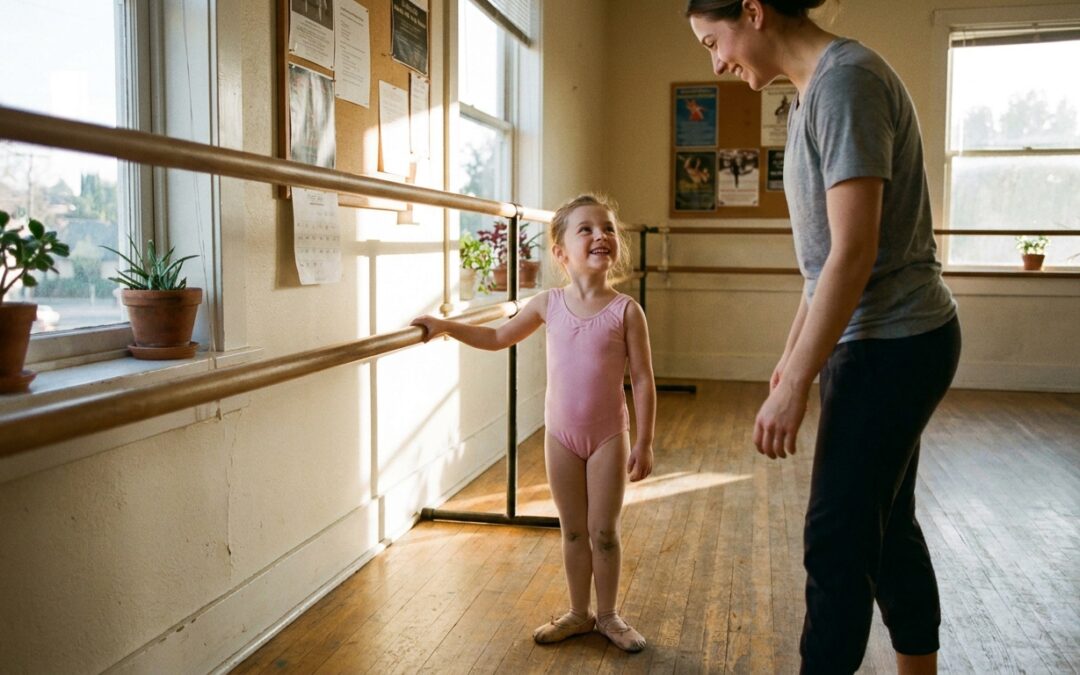
What Is the Right Age to Start Toddler Dance Classes in Arcadia and the San Gabriel Valley?
Most children can start some form of dance as young as 18 months, and the majority of Arcadia and San Gabriel Valley studios enroll preschoolers independently between ages 3 and 5. The honest answer is that developmental readiness matters far more than a birthday. Here is how the age bands typically break down for families searching for toddler dance classes in Arcadia and the San Gabriel Valley.
| Age | Typical Class Format | What to Expect | Parent Required? |
|---|---|---|---|
| 18 months – 2.5 years | Mommy & Me / Parent-and-Child Movement | Rhythm, body awareness, confidence through music and play | Yes, in class |
| 2.5 – 3 years | Toddler Creative Movement | Free exploration, animal movements, simple direction-following | Waiting room or brief drop-off |
| 3 – 4 years | Pre-Ballet / Creative Movement | Basic positions, gross motor skills, classroom etiquette | Drop-off (30–45 min class) |
| 4 – 5 years | Kinderballet / Pre-Ballet II | Structured vocabulary, posture, short combinations | Drop-off |
| 5 – 7 years | Foundational technique (ballet, jazz, hip-hop, K-pop) | Real technique, focus, coordination support serious training | Drop-off; performing-arts track begins |
Local note for SGV families: Many Arcadia-area studios, including recreation-focused programs in Monrovia, Pasadena, and Temple City, offer open year-round enrollment rather than a strict September start. If your child turns 3 in February, you do not have to wait until fall. Expect a non-refundable annual registration fee of roughly $25–$50 at most local studios, plus monthly tuition and end-of-season costume fees if the program includes a recital.
Is My Toddler Ready for Dance Class? The Readiness Signs to Check
Readiness is not purely about age. Look for these observable behaviors before you book a first class.
- Follows simple two-step directions at home (“put your hands up, then spin around”)
- Enjoys moving to music, even spontaneously dancing in the kitchen or copying actions in a song
- Can separate from you briefly in a familiar or semi-familiar setting without prolonged distress
- Walks and jumps with basic control and can balance on one foot for a moment
- Engages in short group activities, even imperfectly, a toddler who can listen, join in, and recover after a distraction is typically ready
- Shows curiosity about dance, asks to watch performances, or imitates what they see on screen
- Is fully potty-trained (required at many drop-off studios across the SGV, so confirm with each program before enrolling)
No toddler is expected to stand still and focus for long stretches. The key question is whether your child can re-engage after a distraction and respond to gentle redirection from a teacher. If most of the signs above apply, your child is likely ready, even if they are on the younger end of the age range.
What About Separation Anxiety? Is Crying at the First Class Normal?
Yes, completely. Some children walk straight in; others need a few weeks to adjust. A little hesitation at the door is not a sign that your child is not ready for dance, it is developmentally normal for toddlers and preschoolers experiencing any new group setting for the first time. What matters is how the studio handles that moment. Experienced early-childhood instructors guide the transition with patience rather than pressure, and most children are smiling and moving freely well before class ends.
A few practical things that help SGV families:
- Visit the studio once before the first class so the space feels familiar.
- Arrive five minutes early so your child can watch the previous class end through a window.
- Keep your own goodbye short and confident, a long, anxious farewell signals to your child that the room is uncertain territory.
- Ask whether the studio has a viewing window. Many SGV programs schedule a Watching Week or parent-observation day so you can see the class without disrupting it.
What Are the Different Class Types? Creative Movement vs. Pre-Ballet vs. Kinderballet
These terms get used interchangeably around the SGV, so here is a plain breakdown of what each actually delivers.
| Class Name | Ages | Focus | Best For |
|---|---|---|---|
| Parent-and-Child / Mommy & Me | 18 mo – 2.5 yr | Rhythm, body awareness, bonding through movement | First introduction to a dance environment; no separation required |
| Creative Movement | 2.5 – 5 yr | Free exploration, imaginative play, basic spatial awareness; no formal technique | First independent class; builds listening and group skills |
| Pre-Ballet | 3 – 4 yr | Basic ballet positions, posture, gross motor skill development through storytelling and games | Children ready for gentle structure and a teacher-led format |
| Kinderballet / Pre-Ballet II | 4 – 5 yr | Expanded ballet vocabulary, longer combinations, beginning musicality | Preschoolers with some class experience who want more challenge |
| Foundational Dance (ballet, jazz, hip-hop, K-pop) | 5 – 7 yr | Real technique, style-specific training, performance preparation | Kindergarteners and early-elementary students ready for a structured performing-arts pathway |
The progression matters. Creative movement and pre-ballet classes plant the coordination and listening foundations that genuine technique training depends on. Children who move through this sequence arrive at age 5 or 6 ready to absorb real instruction rather than spending the first year learning how to be in a classroom.
Rec Class vs. Performing-Arts Track: Which Does Your SGV Child Actually Need?
Most studios you will find in an Arcadia or San Gabriel Valley search, Yelp aggregators, preschool-affiliated programs, recreational chains, are pure recreation tracks. The goal is fun, a year-end recital, and basic movement exploration. That is a perfectly valid choice for a 3-year-old, and it is exactly what the parent-and-child and creative movement formats are designed to deliver.
The question changes at around age 5. If your child is asking when the next class is, practicing at home without being told, or expressing interest in performing, competing, or being on a stage with an audience, a recreation class will not hold them for long. That is the moment to look at a studio with a personalized pathway from foundational training to real performance.
Creation Talent Academy’s programs in Arcadia begin at age 5 and are structured specifically for this transition, small classes of just 4 to 8 students, taught by working industry professionals, with a personalized growth path from the first class through advanced performance work. New students are welcome year-round and the first class is free, so there is no semester-start pressure for SGV families ready to make the move from preschool exploration to real training.
If your child is in elementary school and dance is their main focus, CTA’s partnership with KOD USA is worth knowing about. The KOD after-school dance program at CTA Arcadia launched in Fall 2026 and offers professional hip-hop, K-pop, urban dance, choreography, and performance training specifically designed for elementary-age students, combining street-dance training with after-school homework help and math and English support under one roof.
What Should My Child Wear to a First Dance Class in Arcadia or the SGV?
For a first creative movement or pre-ballet class, dress your child in whatever they can move freely in. Strict dress codes are rare at the toddler and preschool level. Here is a practical guide by style:
- Ballet / Pre-Ballet / Creative Movement: Leotard and tights plus ballet slippers is the standard look, but fitted leggings and a t-shirt with bare feet or socks work fine for a trial class. Avoid jeans or anything with buttons and zippers.
- Jazz / Lyrical: Leotard and leggings or dance shorts; jazz shoes or bare feet.
- Hip-Hop / Street Dance / K-Pop: Comfortable athletic wear, joggers, t-shirt, sweatshirt, plus clean sneakers or slip-on jazz shoes. Do not wear outdoor shoes that have been on pavement.
- All styles: Hair pulled back off the face. No loose jewelry or dangling accessories.
Many SGV studios stock beginner shoe packages or can point you to nearby dance-supply retailers in Arcadia and Monrovia. Buy the shoes after the first trial class, once you know the program is the right fit, rather than before.
How to Use a Free Trial Class to Make the Right Decision
A free trial is not just a marketing gesture, it is your most reliable decision tool. Use it deliberately.
- Watch the teacher, not just your child. Does the instructor get physically down to the children’s level? Do they redirect without shaming? Do they keep the energy calm but engaged?
- Notice the class size. A creative movement class of 12 kids and one adult will be chaotic for a toddler still learning to separate. Smaller groups (4–8) allow teachers to catch a hesitant child quickly.
- Ask about the drop-off protocol. Can you stay nearby the first week? Is there a viewing window? A good studio has a clear, gentle process for the transition.
- Check enrollment logistics. Does the program run semester-only or year-round? What is the registration fee, and is it refundable? Is a costume fee separate from tuition?
- Read your child’s exit energy. A toddler who is still buzzing, talking about class, or asking “when do we go back?” is telling you the answer clearly.
CTA’s foundational programs (starting at age 5) offer a free group trial class so Arcadia and SGV families can experience the teaching style, class size, and environment before committing to enrollment. There is no obligation and no semester-start waiting period.
What Happens After the Preschool Years? Bridging to Real Training at Age 5 and Beyond
The creative movement and pre-ballet years are valuable, but they are a runway, not a destination. Children who spend ages 3–5 in structured play-based classes arrive at kindergarten with better bilateral coordination, stronger spatial awareness, and the classroom habits that make technique training click faster. The transition to formal instruction typically happens between 5 and 7, when focus and coordination can support style-specific vocabulary.
For families in Arcadia, Temple City, Monrovia, Pasadena, and across the San Gabriel Valley, that transition point is worth planning for. If your child’s current preschool dance studio does not offer a clear pathway into performing-arts training, you may find yourself searching for a new studio at 6 or 7 anyway. Knowing where you want to land makes the early years more purposeful.
CTA’s faculty includes instructors who have worked on The Voice, Broadway, American Idol, and major film productions. The academy’s CTA x KOD partnership also brings one of the world’s most recognized street-dance platforms directly to Arcadia for elementary-age students. When your preschooler grows into that 5-to-7 window, this is the kind of program worth having on your radar.
If you are also thinking ahead to performing arts more broadly, our guide to your child’s first dance recital covers exactly what to expect when that first performance moment arrives. And when your child is ready to explore voice or acting alongside dance, CTA’s guide to choosing a performing arts school in Arcadia helps SGV parents compare their options with clear criteria.
Common Mistakes to Avoid
- Enrolling before the potty-training milestone. Most SGV drop-off studios require it. Confirm before you pay a registration fee.
- Buying full gear before the trial class. Ballet slippers, tap shoes, and costume packages add up. Wait until you know the program fits.
- Pulling a tearful child after one class. Some separation anxiety at the door is normal. Give it at least two or three sessions before drawing conclusions.
- Choosing a studio based on location alone. Class size, teacher experience, and the studio’s ability to handle toddler transitions matter more than a five-minute shorter drive.
- Assuming semester-only enrollment. Many Arcadia-area programs enroll year-round. A mid-year start is often available and avoids a months-long wait.
- Skipping the transition conversation. If your child is approaching 5, ask the studio what the next level looks like. A program with no clear pathway after pre-ballet may leave you searching for a new studio at the exact moment your child’s interest peaks.
- Conflating recreation and performing-arts tracks. Both are valid, but they lead to different places. Know which one you are choosing and why.
Frequently Asked Questions
What is the youngest age a toddler can start dance classes in Arcadia or the San Gabriel Valley?
Parent-and-child creative movement classes typically start as young as 18 months. Independent drop-off classes usually begin at 2.5 to 3 years, depending on the child’s readiness and the studio’s format. Most SGV studios offering preschool dance programs enroll children from age 3 for a structured pre-ballet or creative movement class.
Does my child need to be potty-trained before starting dance classes?
For drop-off classes, yes. Many studios in Arcadia and the broader San Gabriel Valley require full potty-training as a condition of independent enrollment. Always confirm with the specific program before registering, since the policy varies. Parent-participation classes for 18-month to 2.5-year-olds generally do not have this requirement.
What is the difference between creative movement and pre-ballet?
Creative movement (typically ages 2.5–5) is play-based and unstructured, focused on rhythm, imagination, and body awareness without formal technique. Pre-ballet (typically ages 3–4) introduces basic ballet positions, classroom etiquette, and gentle structure through storytelling and games. Both are appropriate first classes; pre-ballet simply adds a layer of intentional technical vocabulary.
How do I know if my 3-year-old is ready to separate from me during class?
If your child can follow simple two-step directions, engages in short group activities at preschool or a playgroup, and can recover from minor upsets without prolonged distress, they are likely ready for a drop-off class. Some tears at the door are normal and not a sign of unreadiness. Ask the studio whether you can wait nearby for the first few sessions and whether there is a parent-viewing window.
When should my child move from preschool dance into a real performing-arts program?
Most dance educators and child development specialists point to ages 5 to 7 as the window when focus, coordination, and memory can support genuine technique training. If your child is approaching kindergarten age, shows consistent enthusiasm for dance, and is asking for more challenge than a recreational class provides, that is a strong signal to look at a structured performing-arts program with a clear advancement pathway.