What Are Voice Over Classes for Kids, Really?
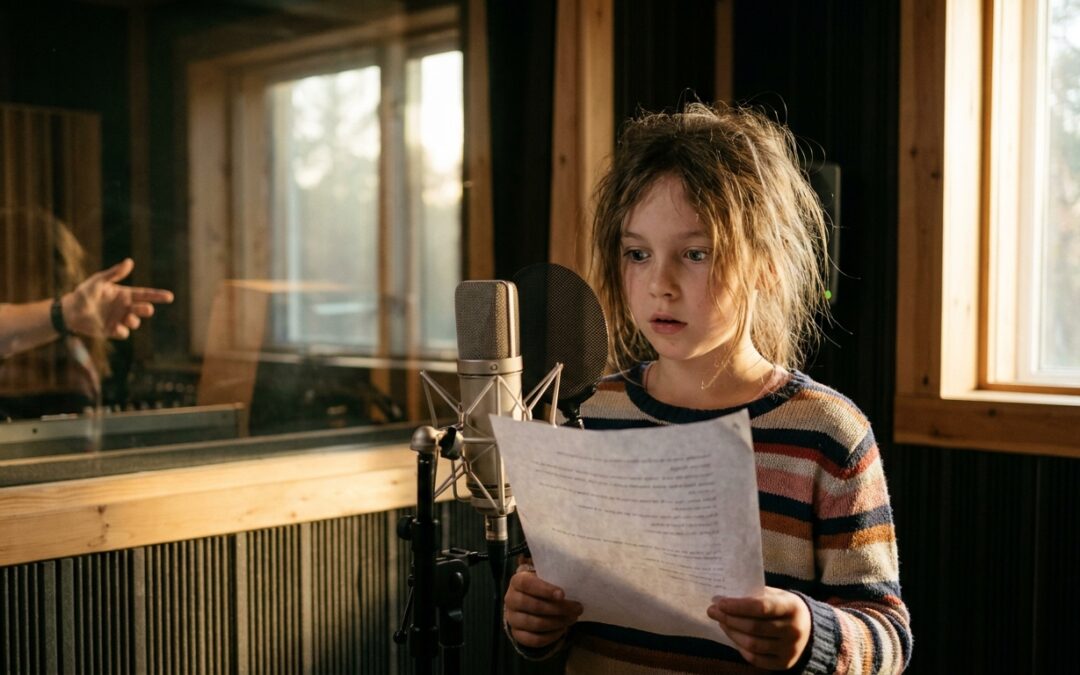
Voice over classes for kids are structured performance training sessions where young students learn to communicate through voice alone, no camera, no stage blocking, no costumes. A child reads from a script into a microphone and is coached on diction, pacing, emotional connection, and character. That’s the whole medium. It sounds simple, but it demands a specific, teachable skill set that is very different from singing and noticeably different from on-camera acting.
Parents in Arcadia, Temple City, San Marino, and Monrovia often mix up the three disciplines. Here’s a plain breakdown:
| Discipline | Primary Skill | Output | Body Involved? |
|---|---|---|---|
| Voice Over | Script performance through voice alone | Recorded audio or live booth read | No |
| On-Camera Acting | Physical + vocal performance | Film, TV, self-tape | Yes, body language is central |
| Singing / Vocal | Pitch, tone, melody, breath control | Live performance or recording | Yes, breath and posture are technical |
VO training reinforces skills that matter across all three lanes. A child who learns to read at the right pace, project warmth, and embody a character without a body to lean on becomes a sharper actor and a more expressive singer. For SGV families whose kids are already enrolled in acting classes in Arcadia or the San Gabriel Valley, VO is a natural complement, not a separate silo.
What Age Can Kids Start Voice Over Training?
The practical starting point for most kids is around age 8, though some programs run up to age 17. Reading ability matters more than age.
Most children can begin voice acting training around age 8, depending on reading ability, focus, and interest in performance. Strong reading skills are important because young voice actors work with scripts, character dialogue, and storytelling. A child who struggles to read fluently will spend class time decoding words instead of performing them, which defeats the purpose.
A useful two-question readiness check for SGV parents:
- Can your child read a paragraph aloud without stopping to sound out words? If yes, they’re likely ready to benefit from VO script coaching.
- Can they take and apply one direction at a time? VO coaching is fast-paced redirecting, “read that line like you’re excited but tired.” Kids who enjoy that kind of creative puzzle tend to thrive.
More advanced youth VO tracks are designed for young actors who are already auditioning or have a strong foundation in basics, and focus on strengthening animation and commercial reads and improving confidence, technique, and booking potential. In other words, there’s a genuine continuum from introductory to intermediate, your child doesn’t need to be “talented” to start, but they do need to be ready to work.
What Copy Types Do Kids Actually Read in VO Class?
Youth voice over training doesn’t have kids pretending to sell insurance. The copy categories are genuinely fun and age-appropriate. Here are the three primary types taught in youth VO programs:
- Animation and cartoon character work. This is what most kids imagine when they think “voice acting.” Students play multiple characters, practice differentiating voices, and learn how to give a character emotional arc across a short scene. Kids and teens classes build confidence, creativity, and real performance skills, and students work with experienced voice actors while learning how to perform for animation and commercials.
- Commercials. Commercial VO is about sounding natural, warm, and persuasive, not announcer-y. Kids read copy for products aimed at their age group and learn the specific technique commercials require. Emphasis is placed on bringing the script to life by creating compelling characters and communicating with listeners.
- E-learning and narration. Educational content platforms produce a high volume of audio narrated by kids for other kids. This category rewards clarity, pacing, and a conversational tone, skills that also transfer directly to public speaking and academic presentations.
Animated features, commercials, cartoons, promos, and audiobooks are expanding, making it a field your child can grow with. As kids move into their teens, video game character work also opens up as a category, which is a major draw for students in the SGV’s gaming-savvy communities.
How Does VO Training Fit With Singing and Acting?
This is the question most local parents haven’t seen answered anywhere, so let’s be direct: voice over training actively makes kids better singers and actors, and vice versa. The three disciplines share a technical core.
| Skill | Used in VO? | Used in Singing? | Used in Acting? |
|---|---|---|---|
| Diction and articulation | Yes, essential | Yes, especially for lyrics | Yes, stage projection |
| Emotional connection to text | Yes, the whole job | Yes, phrasing and intention | Yes, character motivation |
| Pacing and rhythm | Yes, timed reads | Yes, tempo and breath | Yes, scene timing |
| Taking direction quickly | Yes, booth redirects | Yes, vocal coaching | Yes, rehearsal notes |
| Audition resilience | Yes, cold reads under pressure | Yes, callbacks and cuts | Yes, audition rooms |
For kids who are already on an idol or vocal track, VO work specifically sharpens diction and storytelling, two areas that separate polished singers from technically proficient ones. If your child is already exploring K-Pop vocal training for kids in the San Gabriel Valley, VO classes deepen the same interpretive muscle they’re already building. For students prepping musical theater auditions, the cold-reading skill from VO directly applies to sides and script work, a connection covered in our musical theater audition prep guide for Arcadia and SGV parents.
What Does a First Youth VO Class Look Like?
Knowing what to expect removes the anxiety, for the parent and the kid. Here’s a realistic picture of a beginner youth VO session:
- Warm-up. Tongue twisters, breath exercises, and lip trills to loosen the articulators. These are the same techniques vocal coaches use, but applied specifically to speech clarity rather than pitch.
- Script introduction. The instructor gives the student a short piece of copy, maybe a 15-second commercial or a two-character cartoon scene. The student reads it cold while the coach listens.
- Direction and re-read. The coach gives one specific note, speed up, smile through the line, find the character’s age in your voice, and the student reads again. This loop is the core of VO training and repeats throughout the session.
- Playback (if recording is available). Hearing yourself is uncomfortable at first and invaluable for growth. Kids learn to listen critically without self-judgment, which is an audition skill in itself.
- Debrief. The coach summarizes what the student did well and one concrete area to practice before the next session.
Introductory courses for young performers teach the fundamentals of commercial and animation voice over, helping students build confidence through scripts, exercises, and industry-focused guidance while learning what to expect at auditions.
Do Kids Need a Home Recording Booth to Start?
No, and any program that implies otherwise before a child has completed even a semester of training is getting ahead of the process. Beginners need a class, a coach, and a quiet space to practice reads at home. That’s it.
A home booth becomes relevant only when a student is actively auditioning for paid work and needs to submit polished self-recorded demos. For a child in their first year of VO training in Arcadia or Pasadena, the studio’s equipment is the right environment. There are many talented children in the performing arts, but there is much more that goes into casting than just talent, charisma, or natural ability, kids and teens in voice over need to be focused, professional, prepared, and open to direction. Building those qualities happens in the classroom first, not in a closet-turned-booth.
How Do You Choose a Good Youth VO Program Near Arcadia?
The SGV has real local demand for youth VO training, students travel from Alhambra, San Marino, Temple City, Pasadena, Arcadia, and Monrovia to access quality performing arts coaching. Here’s what separates a genuinely useful program from a marketing-heavy one:
- The program frames itself as education, not a ticket to fame. Reputable studios are clear that training builds skills and audition-readiness, not employment or representation. Any program that leads with “your child will book jobs” before they’ve taken a single class is a red flag.
- Instruction is age-specific. Youth VO technique is not a scaled-down version of adult VO coaching. Most children can begin training around age 8, and strong reading skills are important because young voice actors work with scripts, character dialogue, and storytelling. A quality program builds curriculum around how kids actually process and perform copy, not how adults do.
- The coach gives individual redirects, not just group observation. The loop of “read, direction, re-read” is where learning happens. If your child sits in class and watches others most of the time, they’re not getting VO training, they’re watching it.
- VO is taught alongside or integrated with acting fundamentals. Kids who also study on-camera technique and character development grow faster in VO because they have emotional and physical tools to draw from.
- No upfront demo reel pressure. A demo is a marketing tool for working professionals. A beginner student does not need one as a condition of enrollment or within their first term.
Common Mistakes to Avoid
- Enrolling a non-reader in script-based VO training. If your child is still sounding out words, spend that time building their reading fluency first, or explore other performing arts tracks like movement or vocal basics.
- Confusing “doing different voices” with VO skill. Character voices are one tool. The actual skill is emotional truth and script interpretation. A child who can only do “funny voices” hits a ceiling quickly.
- Expecting VO to replace acting or singing training. VO amplifies other performance skills; it doesn’t substitute for them. The strongest youth VO students in the SGV area are almost always also training in acting or singing.
- Buying expensive home recording equipment in the first year. Gear is not the bottleneck for a beginning student. Training is.
- Choosing a program based on industry name-dropping alone. The ability to drop casting director names in marketing copy doesn’t mean your 9-year-old will be seen by those people. Evaluate based on curriculum, coach experience with youth specifically, and class size.
- Skipping the parent orientation or discovery conversation. A good studio for SGV kids will want to understand your child’s current training background, reading level, and goals before recommending a starting point. If enrollment is purely transactional, that’s a signal.
Frequently Asked Questions
What is the right age for voice over classes for kids?
Most children can begin voice acting training around age 8, depending on reading ability, focus, and interest in performance. Many youth VO programs serve students up to age 16 or 17. The real benchmark is reading fluency and the ability to take and apply direction, not a specific birthday.
Does my child need acting experience before starting VO?
No prior acting experience is required for introductory VO classes. That said, kids who have some foundation in acting or singing tend to progress faster because they already understand the concept of performing for an audience and interpreting a script emotionally. For Arcadia-area families, a combined approach often produces the best results.
Are voice over classes different for kids than for adults?
Yes, significantly. Youth VO instruction accounts for a child’s reading level, attention span, and the specific types of copy they’ll realistically be cast in, animation, kids’ commercials, and e-learning. Courses designed for young actors focus on age-specific direction to strengthen animation and commercial reads and improve confidence, technique, and booking potential. Adult VO curriculum, pacing, and copy categories don’t translate directly to a 10-year-old in Arcadia.
Will VO training help my child with singing or musical theater auditions?
Yes. The skills overlap substantially: diction, emotional connection to text, pacing, and the ability to cold-read material and apply a direction in one take. Kids who train in VO alongside singing or acting often find that their overall audition confidence improves because they become more comfortable performing under direction without preparation time.
How much does youth VO training typically cost, and how often should my child attend?
Youth VO classes in the greater Los Angeles and San Gabriel Valley area typically run in 6-to-8-week session formats. Group classes are generally more affordable than private coaching. One session per week is a reasonable starting commitment for a beginner, consistency over the course of one full term matters more than frequency in the first six months. For a broader look at what performing arts training costs across disciplines, our youth performing arts cost guide for SGV families breaks down typical ranges by program type.