What Does a Youth Musical Theater Audition Actually Look Like?
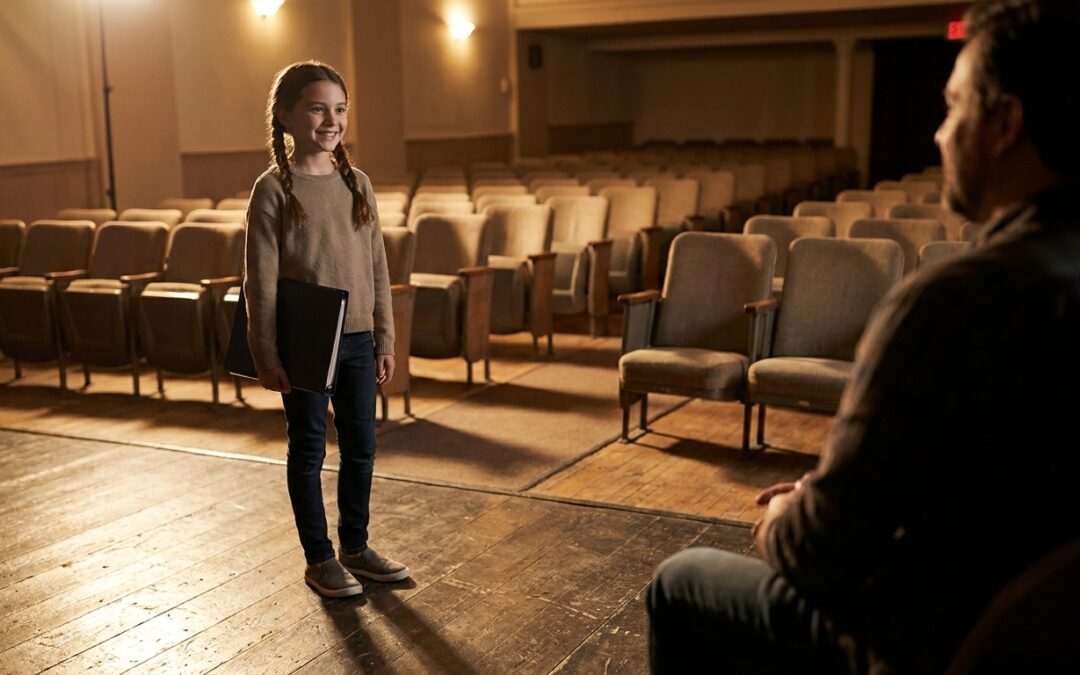
Most youth musical theater auditions in the San Gabriel Valley ask kids to perform a short song cut and, for speaking roles, a brief monologue, typically in front of a director, a music director, and sometimes a choreographer. The whole slot usually runs two to five minutes per child. That’s it. The pressure parents imagine is almost always bigger than the room itself.
Before starting any musical theater audition prep for kids, it helps to know that not every local audition works the same way. There are two very different formats in the SGV, and confusing them is one of the most common parent mistakes.
Format 1: Everyone-Is-Cast (Non-Competitive)
Programs like TESOCAL’s Glendale/Pasadena chapter, which serves Arcadia, Monrovia, Pasadena, and surrounding communities and performs at the historic San Gabriel Mission Playhouse, run roughly 14 weeks of rehearsals leading to a full production. Their model is non-competitive: kids sign up, go through an orientation or light placement process, and are cast. There is no cut. This is a wonderful first experience for beginners ages 5 and up, and the “audition” functions more like a meet-and-greet than a high-stakes call.
Format 2: Competitive-Cast (Parts Are Earned)
School plays, community youth theater productions, and regional programs use a competitive-cast model: roles are assigned based on what you show in the audition room. This is where real prep pays off. The Arcadia Performing Arts Center, a 1,200-seat venue on the Arcadia High School campus that opened in October 2012 and serves the entire Arcadia community, hosts exactly these kinds of productions. So do school drama departments across the SGV from Temple City to Monrovia.
Action step: Before you prep, call or email the production organization and ask two questions: “Is casting competitive or is everyone placed?” and “What materials do you want, song, monologue, or both?” Then prepare accordingly.
| Audition Format | Who It’s For | What to Bring | Local Examples |
|---|---|---|---|
| Everyone-Is-Cast | First-timers, ages 5-10 | Good attitude, comfortable clothes | TESOCAL Glendale/Pasadena, many summer programs |
| Competitive-Cast | Kids with some training, any age | 16-bar song cut, 1-minute monologue, headshot/form | School plays, community theater, Arcadia PAC productions |
What Should My Child Prepare for a Musical Theater Audition?
For a competitive-cast musical theater audition, the standard ask is a prepared song cut and a short monologue. Here is exactly what those mean and how to get them right.
The Song Cut: 16 Bars or 32 Bars
A “cut” is a portion of a song, not the whole thing. Directors don’t want to hear every verse, they want to see how your child handles a focused, story-driven moment. The industry standard for youth auditions is 16 bars (roughly 30-45 seconds) for most calls, and 32 bars (about 60-90 seconds) when the notice asks for “a full cut.” If the notice says “one minute of song,” 16 bars is almost always the right length.
A good cut has a clear beginning, a build, and a defined ending, ideally on a strong note. It should show the comfortable, confident part of your child’s voice, not their ceiling. Picking a song that sits too high is the single most common audition mistake kids make. A director who hears a child sing freely and musically in their easy range is far more impressed than one who watches a child strain for notes they haven’t built yet.
Sheet music goes in a clearly marked, tabbed, highlighted binder, not loose papers, so the accompanist can find the right page instantly. The highlighted portion shows the pianist exactly where to start and stop. This is standard industry practice and it signals that your child (and parent) know the process.
Consistent vocal training builds the range, breath support, and musical ear that make a cut land. The singing lessons for kids at CTA in Arcadia cover all of these foundations in a structured year-round format, which is very different from one or two crash sessions before an audition.
Song Selection by Age Group
| Age Band | Good Song Choices | Avoid |
|---|---|---|
| Ages 5-8 | Simple, story-driven songs from family musicals (e.g., Annie, Matilda, The Sound of Music); short, clear phrases | Belting songs written for adults; anything over 16 bars; pop songs not written for theater |
| Ages 9-12 | Character songs with an emotional arc; material from youth-cast shows; folk or classic musical material in the right key | Overly mature themes; songs that require vocal runs they haven’t mastered; anything currently on the radio |
| Ages 13-18 | Contemporary musical theater cuts; material that matches their type; songs that end on a moment, not just a note | Songs associated with an iconic adult performer; overly dramatic ballads that outpace their acting skills; songs written for the opposite voice part |
The Monologue: One Minute, One Moment
When a youth theater audition asks for a monologue, the target is roughly 60 seconds, never longer unless told otherwise. Pick a monologue written for or appropriate to a child’s age. It should have a clear objective: the character wants something from someone. A monologue with no want is just words on a page.
Younger kids (ages 5-9) do best with short, playful, concrete pieces. Teens can handle more emotional complexity, but the monologue should still be age-appropriate in content. A director does not want to see a 10-year-old perform a breakup speech.
Regular acting training gives kids the tools to make any material feel genuine rather than memorized. The acting classes for kids and teens at CTA build exactly this skill, finding the want, listening, and staying present, in small groups of four to eight students with industry-professional instructors.
How Do I Prepare My Child for Audition Day? (Step-by-Step)
Preparation that happens the week before barely counts. Preparation that happens over months is what books roles. That said, here is how to organize the final week and the day itself.
Week Before
- Run the song cut and monologue every day, but keep it short, two clean run-throughs are better than ten anxious ones.
- Record a run-through on your phone. Watch it together without commentary, then ask: “What do you like? What would you change?” Let your child diagnose, not you.
- Confirm the audition format: open call or sign-up, accompanist provided or backing track, sides/scene packet distributed in advance.
- Assemble the binder: sheet music in a hard binder, highlighted, with the tempo and starting note marked for the accompanist. Bring a printed audition form and a headshot if requested.
- Choose and confirm the audition outfit: age-appropriate, neat, moves well, and comfortable. Nothing flashy enough to distract from the performance.
The Night Before
- Lay out the outfit, binder, water bottle, and any paperwork. Put them by the door.
- Look up parking and travel time. The Arcadia PAC is at 188 Campus Drive; the San Gabriel Mission Playhouse is in San Gabriel, confirm the specific address for any local production.
- Good sleep matters more than one final practice run.
Audition Morning
- Protein breakfast, not sugar. A hungry or sugar-crashing child has a harder time focusing.
- Arrive 10-15 minutes early so your child can see the room, hear the pianist once, and settle their nerves before their name is called.
- Bring something to occupy the wait: a book, headphones, a small game. Long lobby waits are normal at community theater calls.
- Before they go in, one simple cue: “Go in, say hi, and have fun with it.” Not: “Do your best” or “Don’t be nervous” (both focus on anxiety, not performance).
What Happens at a Callback? What Should My Child Know?
A callback means the director wants to see more, it is good news, not a second chance to survive. Callback format for musical theater typically adds one or more of the following elements.
- Dance call: A choreographer teaches a short combination, usually 8-16 counts, and the kids perform it in small groups. The director is watching how quickly children pick up material and how they handle the room, not whether they are the best dancer there.
- Cold sides: Pages from the script handed out at the callback. Kids read them with a scene partner or alone, often with very little prep time. The director is watching listening skills and the ability to make quick, specific choices.
- Redirection: The director asks your child to try something differently, sing the chorus softer, say the line angrier, try it as if you’re in a hurry. This is the most important callback skill. A child who takes the note, tries something genuinely new, and does it with a good attitude will always be remembered, even if they don’t get the part. A child who freezes or gets flustered signals that they may be hard to direct in rehearsal.
Practice redirection at home. Give your child a line or a lyric and ask them to do it three totally different ways. This trains the “yes, and” reflex that directors are looking for. It is also a core skill in improv, another reason improv classes for kids in Arcadia are such a useful companion to musical theater training.
Common Mistakes to Avoid
- Picking a song that’s too high. Straining for the top notes makes the whole cut feel tense. Choose a song where the highest note is well within reach.
- Preparing material that’s too adult. A song or monologue with mature themes pulls focus away from your child’s talent and toward the wrong question.
- Using loose sheet music instead of a binder. Loose pages confuse accompanists, fall on the floor, and signal inexperience. Always use a clearly marked binder.
- Cramming with two or three sessions right before the audition. Short bursts of pre-audition coaching can polish what’s already there, but they can’t build what isn’t. Ongoing training is the only thing that consistently produces bookings.
- Assuming all local programs work the same way. An everyone-is-cast program like TESOCAL and a competitive-cast school production require completely different prep mindsets. Confirm the format first.
- Coaching from the waiting room. Last-minute parent notes just before a child walks in tend to create anxiety, not confidence. Trust the preparation.
- Skipping the callback debrief. Whether your child books the role or not, a short positive debrief (“What did you enjoy? What would you do differently?”) builds the growth mindset that long-term performers all share.
How Does Ongoing Training Actually Change Audition Outcomes?
The difference between a child who books consistently and one who stalls at the audition door is almost never talent. It is preparation depth. Working performers, at every level, keep training between jobs. The same is true for kids.
Regular year-round training in acting, voice, and movement builds three things that two or three pre-audition sessions simply cannot: muscle memory in performance (so nerves don’t erase the work), a body of material the child genuinely knows and owns, and the habit of taking direction as a creative tool instead of a correction.
Creation Talent Academy’s youth musical theater program in Arcadia offers exactly this kind of structured, year-round training for students ages 5 through 18. Classes run in small groups of four to eight, taught by working industry professionals, including Broadway performers and finalists from The Voice and American Idol, so kids are learning from people who have actually navigated the rooms they are preparing for. There is a personalized path from a child’s very first class to real stages, and CTA offers a free first class so families can see the environment before committing.
If you are also looking at the full financial picture of training, the SGV parent’s guide to performing arts class costs breaks down what to expect across different program types so you can plan accordingly.
Frequently Asked Questions
What is a 16-bar cut for a kids’ audition?
A 16-bar cut is a short, selected portion of a song, roughly 30 to 45 seconds, that a child prepares for an audition. The bars are marked in the sheet music so the accompanist knows exactly where to start and stop. It should have a clear beginning, a build, and a strong ending, and should sit comfortably in the child’s natural vocal range.
Do all youth musical theater auditions in the San Gabriel Valley require a song and monologue?
No. Requirements vary widely. Non-competitive, everyone-is-cast programs (like TESOCAL’s Glendale/Pasadena chapter serving Arcadia and Monrovia) may ask for little to no prepared material. Competitive-cast programs, school plays, community theater productions at venues like the Arcadia Performing Arts Center, typically ask for a song cut and sometimes a monologue. Always check the specific call notice or contact the organization directly.
How old does my child need to be to audition for local youth theater?
Most SGV youth theater programs accept children starting around age 5. Non-competitive programs are generally more accessible for the youngest age group, while competitive-cast programs tend to be more age-stratified, with junior and senior divisions starting around age 7-8 and 13-14 respectively. Check each program’s specific age breakdown before registering.
What should my child wear to a musical theater audition?
Neat, put-together clothes that allow free movement. Avoid costumes, flashy accessories, or anything distracting. The outfit should look intentional, not pajamas and not a ball gown. Comfortable shoes the child can actually move in are important, especially if a dance portion is possible.
What if my child forgets their lines or the pianist starts in the wrong place?
They should smile, reset, and keep going. Directors expect small mishaps and they are not disqualifying, the response to a mistake is part of what directors evaluate. A child who recovers with a smile and finishes with energy will be remembered far more positively than one who freezes or apologizes repeatedly. Practice recovery at home: intentionally “make a mistake” mid-run and practice starting again cleanly.