
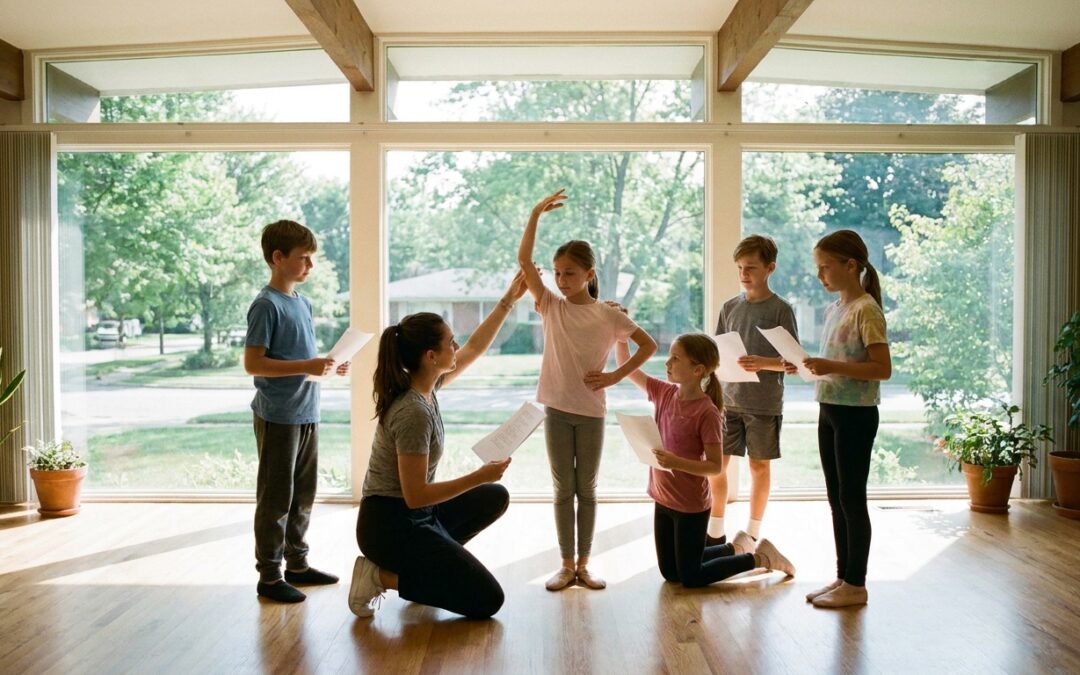
What Are Homeschool Performing Arts Classes, and Why Do SGV Families Choose Them?
Homeschool performing arts classes in the San Gabriel Valley are scheduled during school-day hours, typically mid-morning to early afternoon, and are specifically sized and paced for homeschool students rather than kids coming straight from a full day of traditional school. They give your child structured, skills-based training in acting, dance, or voice while your family retains full control of the academic schedule. For the growing SGV homeschool community, spanning families in Arcadia, Monrovia, Pasadena, and east-valley communities like San Dimas, Glendora, Walnut, and Diamond Bar, these classes solve two problems at once: they fill a meaningful enrichment slot in the week and provide a ready-made peer group outside the home.
The SGV is a genuinely arts-serious market. Institutions like CSArts-SGV in nearby Duarte run ten arts conservatories covering acting, dance, musical theatre, and vocal arts, which signals strong local family demand for serious youth performing-arts training. Homeschool families in this area are not just looking for a fun activity but for training that builds real skills and, for some students, supports an audition or competition track.
Daytime Homeschool Classes vs. After-School Classes: What Is the Actual Difference?
The format difference matters more than most parents realize before they start shopping. Here is a direct comparison:
| Factor | Daytime Homeschool Class | After-School Class |
|---|---|---|
| Typical hours | 9 a.m. – 2 p.m. | 3 p.m. – 7 p.m. |
| Class size | Smaller (often 4–10 students) | Larger (8–20+ students) |
| Student energy | Fresh and focused | Post-school fatigue common |
| Peer group | Mixed-age homeschool cohort | Often grade-separated |
| Academic credit fit | Easy to count as arts or PE block | Works but competes with homework |
| Scheduling flexibility | Higher, studios set times for homeschool demand | Fixed to school dismissal windows |
| Parent logistics | One midday trip; may allow drop-off and local errands | Rush-hour pickup is common |
Smaller daytime cohorts also mean instructors can address individual technique more directly, which matters for beginners who need correction early before habits form.
Can Performing Arts Count Toward Homeschool Credits or Charter Enrichment Funds in California?
Yes, with some important distinctions depending on how you homeschool.
If you file a Private School Affidavit (PSA): You design your own curriculum, so you can absolutely log dance, acting, or voice as your arts credit or physical education hours. Keep a simple attendance and activity log in case you need records later, especially for high-school transcripts.
If you are enrolled in a California charter independent-study program: This is where real funding becomes available. California families who enroll their child as a public charter student gain access to an instructional allotment. Current 2025–26 ranges run roughly $2,200–$2,800 per year for elementary students and up to around $3,800 for high schoolers, though amounts vary by program and recent budget cycles have reduced some stipends. Charter funds can be spent on approved curriculum, tutoring, online classes, and enrichment vendors, and many charters explicitly approve music lessons, arts workshops, and similar performing-arts instruction. You spend through the charter’s approved vendor list, so confirm with your specific charter that a given studio is eligible before enrolling.
If your child receives Regional Center services (SDP): California’s Self-Determination Program gives families with children who have developmental disabilities more control over how Regional Center funds are spent. SDP participants develop an individualized budget with their service coordinator and can choose providers outside the traditional vendor list, making performing-arts instruction a realistic option for eligible families. CTA serves students through the SDP program, so parents in this situation should ask directly about that pathway.
Important: California has no statewide Education Savings Account program as of 2026. Independent homeschool families who do not enroll in a charter cannot access public instructional funds. Always verify current allowable-expense rules directly with your charter coordinator before purchasing anything, as policies change with budget cycles.
How Do You Choose a Homeschool-Friendly Performing Arts Studio in Arcadia or the SGV?
Not every studio is built for homeschool families even if it technically offers a class that falls before 3 p.m. Use this checklist when evaluating options:
- Daytime availability confirmed: Ask for the specific days and times of homeschool or daytime classes, not just whether they exist.
- Year-round enrollment vs. drop-in: Year-round enrollment builds faster skill progression and a consistent peer group. Drop-in works for families with irregular weeks but should not be the default for a child who is serious about developing a skill.
- Free trial class: A studio confident in its instruction offers a no-commitment first session. Use the trial to assess teacher communication style and whether your child leaves energized or deflated.
- Mixed-age daytime cohort: Homeschool classes often mix ages, which is a feature, not a flaw. Younger kids model behavior from older students; older students build leadership habits naturally.
- Breadth of disciplines under one roof: If your child wants to explore acting and dance without being driven to two separate studios, look for a program that covers both. Combining disciplines in one location protects your driving time and your child’s energy.
- Special-needs support: If your child has learning differences, sensory sensitivities, or an IEP, ask specifically whether the studio has experience with neurodiverse learners and whether they work with SDP families.
- Clear performance or recital pathway: Progress is most visible when students have something to work toward. Ask when showcases or performances happen and whether participation is required or optional.
- Instructor credentials and stability: Long-term instructors who know your child’s baseline matter more than a rotating roster of guest teachers.
What Does a Realistic Homeschool Week Look Like With Performing Arts?
The most common mistake SGV homeschool parents make is treating performing-arts classes like a single homework assignment when they are actually more like a sport, with physical demands, emotional processing after class, and practice that extends into home time. A schedule that works typically looks like this:
- Core academics in the morning (reading, math, writing): 8–11 a.m.
- Performing-arts class block: 11 a.m. – 1 p.m. (one to three days per week depending on discipline and level)
- Lunch and decompression: built in, not skipped
- Light independent study or project work in the afternoon
- One park-day or co-op day per week for broader socialization
Building one shared family calendar for lessons, rehearsals, and project deadlines is the single most effective logistical tool. Color-code it by child and protect two to three unstructured evenings per week, especially for elementary-age kids. Watch for over-commitment signs: persistent tiredness, mood swings after class rather than energy, and slipping enthusiasm for an activity your child previously loved. Those signals usually mean the schedule needs a trim, not that the activity itself is wrong.
Age-by-Age Guide: Which Disciplines Fit Which Homeschoolers?
| Age Range | Best Starting Discipline | What to Expect | Progression Path |
|---|---|---|---|
| Ages 5–7 | Creative movement / beginner dance | Short attention spans; play-based instruction works best | Add structured dance or beginner acting by age 7–8 |
| Ages 8–10 | Dance + acting or musical theatre combo | Ready for technique basics; group scenes and simple choreography land well | Introduce voice/singing by 9–10 if interest is there |
| Ages 11–13 | Acting, hip-hop / K-pop dance, or vocal training | Strong identity-forming stage; genre matters more; peers matter enormously | Audition prep and competition track become realistic |
| Ages 14–18 | Specialized track: idol vocal, on-camera acting, competitive dance | Teens respond best to professional-level instruction and real performance goals | Regional auditions, college portfolio prep, competition teams |
For parents of younger homeschoolers just starting out, the guide on when toddlers are ready for dance classes in Arcadia covers the developmental readiness markers in detail. For teens on a more serious track, the teen acting classes guide for the San Gabriel Valley covers what to look for in a teen-specific program.
How Does CTA in Arcadia Serve Homeschool Families?
Creation Talent Academy in Arcadia is specifically set up for the logistical reality of homeschool families. The program offers year-round acting, singing, dance, martial arts, and public speaking for ages 5–18 under one roof, which means a homeschool parent can schedule multiple disciplines in a single trip rather than driving to separate studios across the SGV. The academy also provides homework help and English and math academic support alongside performing-arts training for elementary students, a practical option for families who want enrichment and light academic reinforcement in the same block of time.
CTA offers a free trial class, which makes it straightforward to test fit before committing to enrollment. The studio also serves students through the Self-Determination Program (SDP), so families whose children receive Regional Center services should ask about that pathway directly.
For Fall 2026, CTA is launching a new hip-hop and K-pop dance program as an Official KOD (Kinjaz of Dance) Partner, bringing a professional street-dance training format to Arcadia. For homeschool teens interested in the idol or competition track, this is a meaningful addition. See the full announcement on the CTA x KOD Arcadia Fall 2026 program page.
Families exploring the full range of performing-arts options can also review the how to choose a performing arts school in Arcadia guide for a broader framework that applies to homeschool and traditionally schooled students alike.
How Do Homeschool Performing Arts Classes Support Socialization?
This is the most frequent secondary concern parents raise, right after scheduling. Group performing-arts classes solve the socialization question in a way most academic co-ops do not, because the work is inherently collaborative. Students learn to take direction together, give feedback, share stage space, and celebrate each other’s performances. A mixed-age daytime cohort also mirrors real-world social structures more closely than a grade-sorted classroom does.
The SGV has an active organized homeschool community with park-day groups spanning San Dimas, Glendora, Claremont, West Covina, Rowland Heights, Covina, Walnut, and Diamond Bar. Connecting a weekly performing-arts class to an existing park-day group gives a homeschooled child two distinct social circles, the performing-arts peer group and the broader homeschool community, which is closer to the social breadth a traditionally schooled child has.
For children who are shy or nervous about group settings, the performing-arts environment is often better than a standard co-op because there is a clear activity to focus on rather than unstructured socializing. Students bond over shared effort rather than having to generate conversation from scratch.
Common Mistakes to Avoid
- Treating daytime as automatically flexible. Some studios list morning times but do not actually run a dedicated homeschool section. Confirm the class is designed for homeschoolers, not just scheduled before 3 p.m. for logistical reasons.
- Stacking too many disciplines too fast. Starting a child in dance, acting, and voice simultaneously in the first semester almost always leads to burnout or declining quality in all three. Pick one or two disciplines and add a third after a full semester.
- Skipping the free trial. No amount of good reviews replaces watching your child in the room with that instructor for 45 minutes. Always use the trial before committing to a term.
- Assuming charter funds cover any studio automatically. Charter enrichment funds must be spent through approved vendors. Verify your charter’s vendor approval process before enrolling and paying out of pocket expecting reimbursement.
- Neglecting downtime. A homeschool schedule filled with enrichment classes from 9 a.m. to 4 p.m. five days a week is still an overloaded schedule. Protect at least two unstructured afternoons per week, especially for children under 12.
- Choosing a studio solely on proximity. A 15-minute longer drive to a studio with the right instructor, small class size, and daytime homeschool structure is nearly always worth it over the closest option that does not fit.
Frequently Asked Questions
Can dance or acting classes count as PE or arts credit for a California homeschooler?
Yes. If you homeschool under a Private School Affidavit, you set your own curriculum, and dance classes can count toward physical education hours while acting or voice count toward visual/performing arts. Keep a dated log of class attendance and what skills were covered. For charter-enrolled students, ask your educational specialist how to log enrichment classes on your student’s learning plan.
Do California charter schools pay for performing arts lessons at outside studios?
Many California charter independent-study programs approve enrichment classes including arts instruction as part of the student’s instructional allotment. Charter enrichment funds currently range from roughly $2,200 to $3,800 per student per year depending on grade level and charter program, though recent state budget cycles have reduced some stipends. The studio must be on or added to your charter’s approved vendor list, so confirm this before enrolling and paying privately expecting reimbursement later.
What if my homeschooled child has special needs or receives Regional Center services?
California’s Self-Determination Program (SDP) gives families of children with developmental disabilities more control over how Regional Center funds are used, including the ability to choose providers outside traditional vendor lists. Performing-arts instruction can be an eligible use of SDP funds when it aligns with goals in the child’s Individual Program Plan. CTA in Arcadia has experience serving SDP families, so contact the studio directly to discuss how that works in practice. For a broader overview, the SGV parent’s guide to inclusive performing arts classes for kids with special needs is a useful starting point.
How many days per week should a homeschooled child take performing arts classes?
One to two days per week is the right starting point for most children under 12. At that frequency, a child builds real skills, maintains enthusiasm, and still has enough bandwidth for academic work and unstructured play. Children 13 and older pursuing a specific track, such as audition prep, competition dance, or idol-style vocal training, can sustain two to three days per week without overload if the rest of their schedule is protected. Add days only after a full semester at the lower frequency confirms the child is genuinely energized by the training.
Is Arcadia a practical location for SGV homeschool families from surrounding cities?
Yes. Arcadia sits centrally in the San Gabriel Valley and is accessible from Monrovia, Duarte, Temple City, El Monte, Rosemead, and Pasadena without freeway dependence. From the eastern SGV (Glendora, San Dimas, Walnut, Diamond Bar), the drive is typically 20–30 minutes on surface streets. Families who already do a park-day or co-op in the Arcadia or Pasadena area can often pair a class at CTA with an existing errand or social stop in the same trip.